AppAuto AI Platform
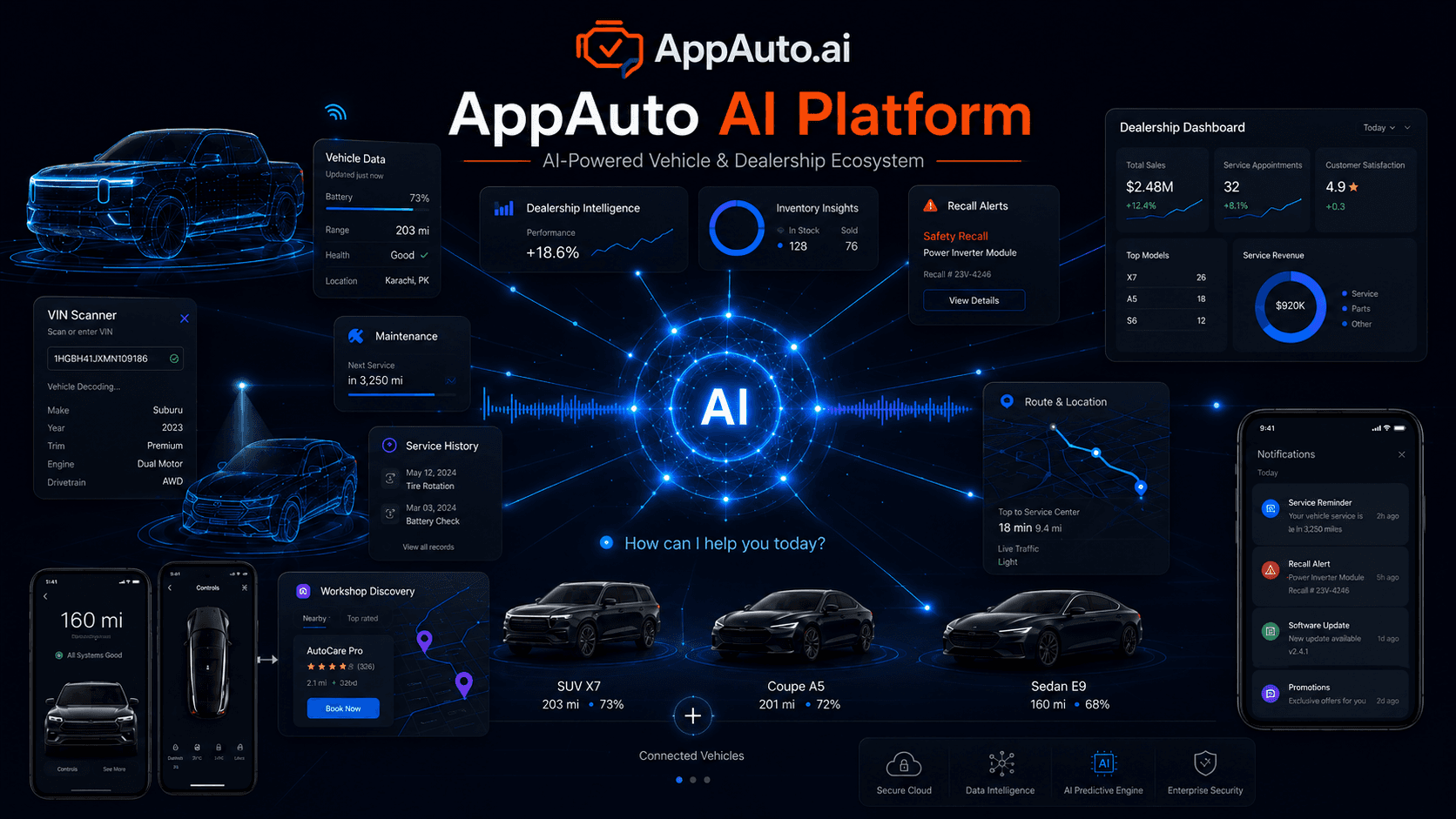
AI-powered AppAuto platform for vehicle owners and dealerships, combining mobile garage management, VIN decoding, recalls, service history, admin analytics, and a Claude-powered text and voice assistant connected to real vehicle data.
Overview
AppAuto AI Platform is a full-stack AppAuto SaaS ecosystem built for dealerships and vehicle owners. The platform includes a Node.js/Express REST API backend, a React-based dealership admin panel, and a Flutter mobile application for vehicle owners. It connects users with their vehicles, dealerships, recalls, maintenance records, service history, nearby workshops, notifications, and an AI AppAuto assistant. The core feature is an AI assistant powered by Anthropic Claude with tool-calling capabilities. Instead of giving generic responses, the assistant can fetch authenticated user data such as vehicle details, recalls, maintenance checks, transfer status, and profile information. The same intelligence is also exposed through a voice assistant using speech-to-text and text-to-speech pipelines. The system was designed as a real-world AppAuto ownership platform where dealerships can manage users, employees, offers, analytics, vehicles, service bulletins, and customer engagement, while vehicle owners can manage their garage, scan VINs, track recalls, upload service records, and interact with an AI assistant.
- 3 Apps
- Product Surface
- Text + Voice
- AI Experience
- 28+
- Data Models
- 10+
- Integrations
Problem statement
Vehicle owners often depend on scattered systems to manage car information, service history, recalls, maintenance schedules, dealership communication, and ownership documents. Dealerships also lack a unified digital platform to manage customer engagement, vehicle records, service insights, offers, employees, and analytics in one place. The goal of this project was to build a connected AppAuto platform that brings vehicle ownership, dealership operations, AI assistance, service workflows, recalls, notifications, and analytics into one unified ecosystem.
Business impact
Built a connected AppAuto AI ecosystem that supports both dealership operations and vehicle owner experiences. The platform enables vehicle owners to manage their cars, decode VINs, track recalls, upload service records, discover nearby workshops, receive notifications, and interact with an AI assistant through text and voice. For dealerships and administrators, the platform provides user management, dealership management, employee management, analytics, offers, service bulletins, notifications, and operational dashboards. The project demonstrates full-stack product engineering across backend APIs, AI integration, mobile development, admin dashboards, third-party AppAuto APIs, and production deployment workflows.
Architecture overview
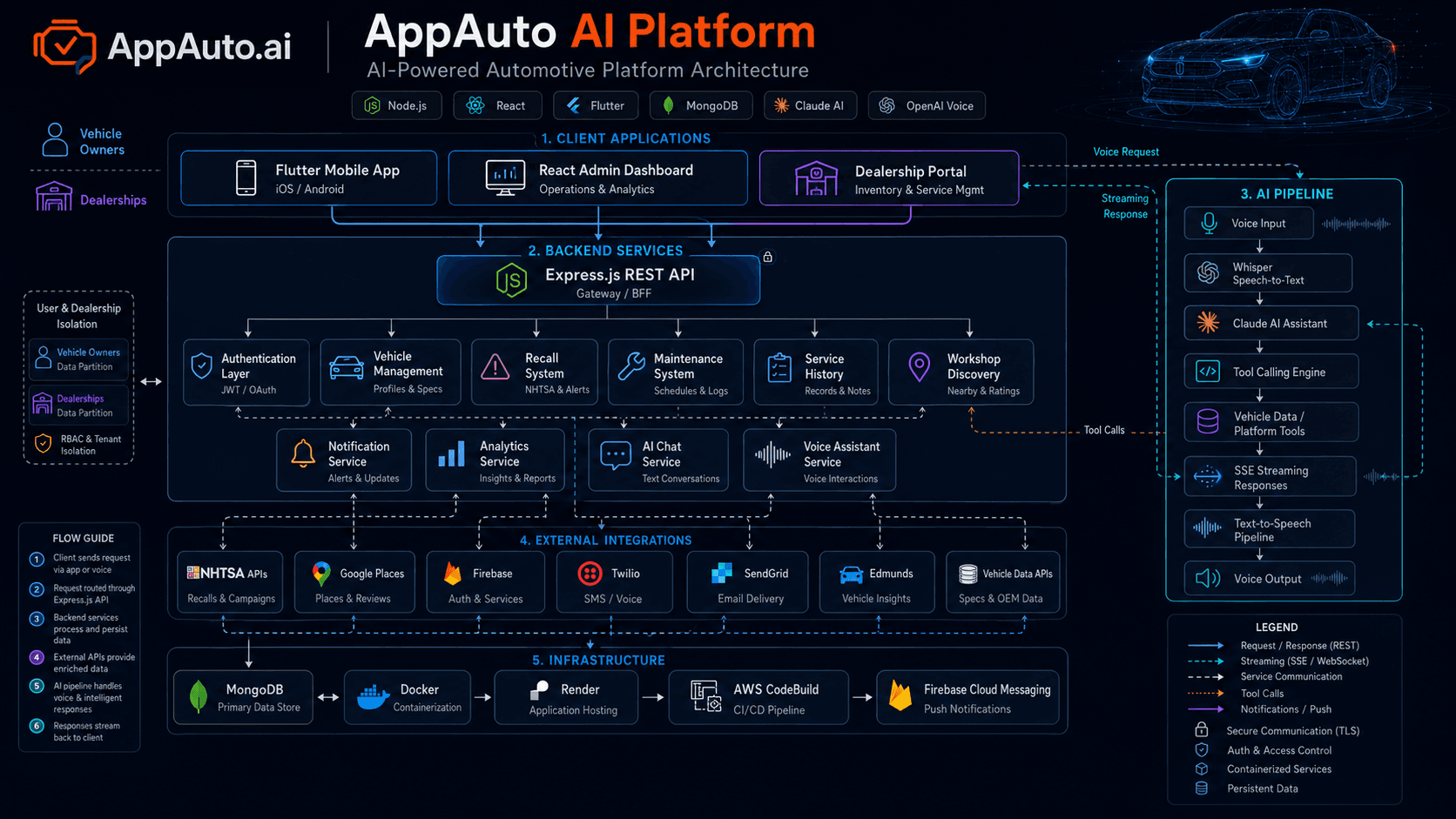
- Node.js and Express REST API backend with modular route structure
- MongoDB and Mongoose data layer with domain-specific models
- React admin dashboard connected through typed service modules and React Query hooks
- Flutter mobile app with layered architecture using data, domain, and presentation modules
- Claude-powered AI assistant with bounded tool-calling loop
- SSE streaming for real-time AI chat responses
- Voice assistant pipeline using audio upload, Whisper transcription, Claude reasoning, and TTS response
- JWT-based authentication with role-based access control
- Firebase Cloud Messaging for push notifications
- Third-party AppAuto integrations including NHTSA, Google Places, Edmunds, and vehicle data APIs
- Docker-based deployment workflow with AWS CodeBuild and Render support
Architecture decisions
- 01
AI Assistant With Tool-Calling
The assistant was designed to access real authenticated vehicle data instead of only generating generic AppAuto advice.
- 02
Separate Mobile and Admin Experiences
Vehicle owners and dealership staff have different workflows, so the system uses a Flutter mobile app for owners and a React admin dashboard for operational teams.
- 03
MongoDB for Flexible AppAuto Data
Vehicle records, recalls, service history, offers, analytics, and dealership data have flexible structures, making MongoDB suitable for rapid product development.
- 04
SSE Streaming for AI Chat
Streaming improves the mobile chat experience by showing AI responses progressively instead of waiting for a full response.
- 05
Multi-Channel Notification System
The platform uses push notifications, email, and SMS to support customer engagement, alerts, service updates, and dealership communication.
Technical challenges
- Connecting AI responses with authenticated user-specific vehicle data
- Designing text and voice assistant flows for mobile users
- Handling VIN decoding, recalls, maintenance, and vehicle ownership workflows
- Building separate experiences for vehicle owners, dealerships, employees, and administrators
- Integrating multiple external services including NHTSA, Google Places, Firebase, Twilio, SendGrid, Anthropic, and OpenAI
- Managing real-time AI streaming responses in the mobile app
- Structuring a large AppAuto domain with vehicles, recalls, service history, offers, workshops, notifications, and analytics
Security
- JWT-based authentication and protected API routes
- Role-based middleware for admin, dealership, employee, and regular users
- Authenticated AI tool-calling scoped to the current user only
- Password hashing using bcrypt
- OTP verification and password reset workflows
- CORS allowlist and Helmet security middleware
- PIN-protected file manager for sensitive documents
- Centralized token handling in web and mobile clients
Performance
- SSE-based AI response streaming for faster perceived response time
- Bounded Claude tool-calling loop to control latency and cost
- Mobile repository layer with reusable network response handling
- React Query caching and invalidation in the admin panel
- Optimized dashboard service layer for analytics and CRUD workflows
- Graceful backend shutdown and optional Node cluster mode
Key features
- Claude tool-calling connected to real vehicle data
- Vehicle garage management for owners
- VIN decoding and VIN scanning
- NHTSA recall lookup and campaign tracking
- Maintenance schedules and urgent service checks
- Service history upload with AI invoice extraction
- Dealership and employee management
- Admin analytics dashboard
- Marketing offers and engagement tracking
- Push, email, and SMS notifications
- Google and Apple social login
- Nearby workshops and dealership discovery
- File manager with PIN protection
- Mobile, web admin, and backend API ecosystem
- AI AppAuto assistant with text and voice support
Deployment approach
- Backend deployable through Docker, Render, and AWS CodeBuild workflows
- React admin panel built with Docker and AWS ECR/ECS deployment support
- Flutter mobile app configured for Android, iOS, macOS, and web targets
- Production API connected through environment-based configuration
- Swagger documentation available for backend API testing
Scalability strategy
- Modular backend route and service organization
- Domain-based Mongoose models for AppAuto platform features
- Separate clients for mobile users and dealership administrators
- AI assistant designed with reusable tools for future vehicle-related capabilities
- Notification infrastructure prepared for push, email, and SMS communication
- Admin analytics foundation for dealership growth and engagement tracking
Future scaling considerations
- Complete integration of remaining dealership portal modules
- Production hardening of rate limiting and dev route access
- Advanced dealership CRM, finance, inventory, parts, and trade-in workflows
- Expanded AI diagnostic assistant capabilities
- Improved analytics and reporting dashboards
- Stronger production TLS and certificate validation on mobile
- More advanced recall, maintenance, and service recommendation intelligence
- Role-based protected routing in the admin frontend
Engineering trade-offs
- Express.js was used for faster delivery, while NestJS could provide stronger enterprise structure for future scaling
- MongoDB enabled flexible AppAuto data modeling, but relational reporting may require aggregation optimization
- AI tool-calling improves personalization but adds cost, latency, and timeout handling requirements
- LocalStorage token handling simplified frontend integration but should be hardened for enterprise-grade security
- Multiple third-party APIs accelerated product capability but require strong fallback and error handling strategies
Tech stack
- Node.js
- Express.js
- MongoDB
- Mongoose
- React
- TypeScript
- Vite
- Flutter
- Dart
- Firebase
- Anthropic Claude
- OpenAI Whisper
- Twilio
- SendGrid
- Google Places
- NHTSA APIs
- Docker
- AWS CodeBuild
- Render
More case studies
Enterprise Auth Platform
Production-grade authentication and authorization infrastructure for modern SaaS and enterprise applications — featuring multi-tenancy, RBAC + ABAC, refresh-token rotation, session management, queue-driven architecture, and tenant-scoped security.
Enterprise Telecom Business & Ecommerce Portal
Enterprise Angular 16 telecom platform for a Canadian telecommunications company, featuring business-side portal flows, ecommerce checkout, payment gateway integration, address lookup, SEO improvements, and Contentful-driven dynamic page and component rendering.
Enterprise Membership Management SaaS Platform
Confidential enterprise multi-tenant membership management SaaS platform built with Angular, Nx monorepo, NgRx Signals, shared UI libraries, dynamic websites, programs, events, payments, reporting, permissions, and white-label tenant products.
Start a similar project
Need a similar ai appauto saas platform built end-to-end?
I can help plan, build, and ship a production-ready version of this type of system for your business — same engineering discipline, scoped to what you actually need.