Enterprise Auth Platform
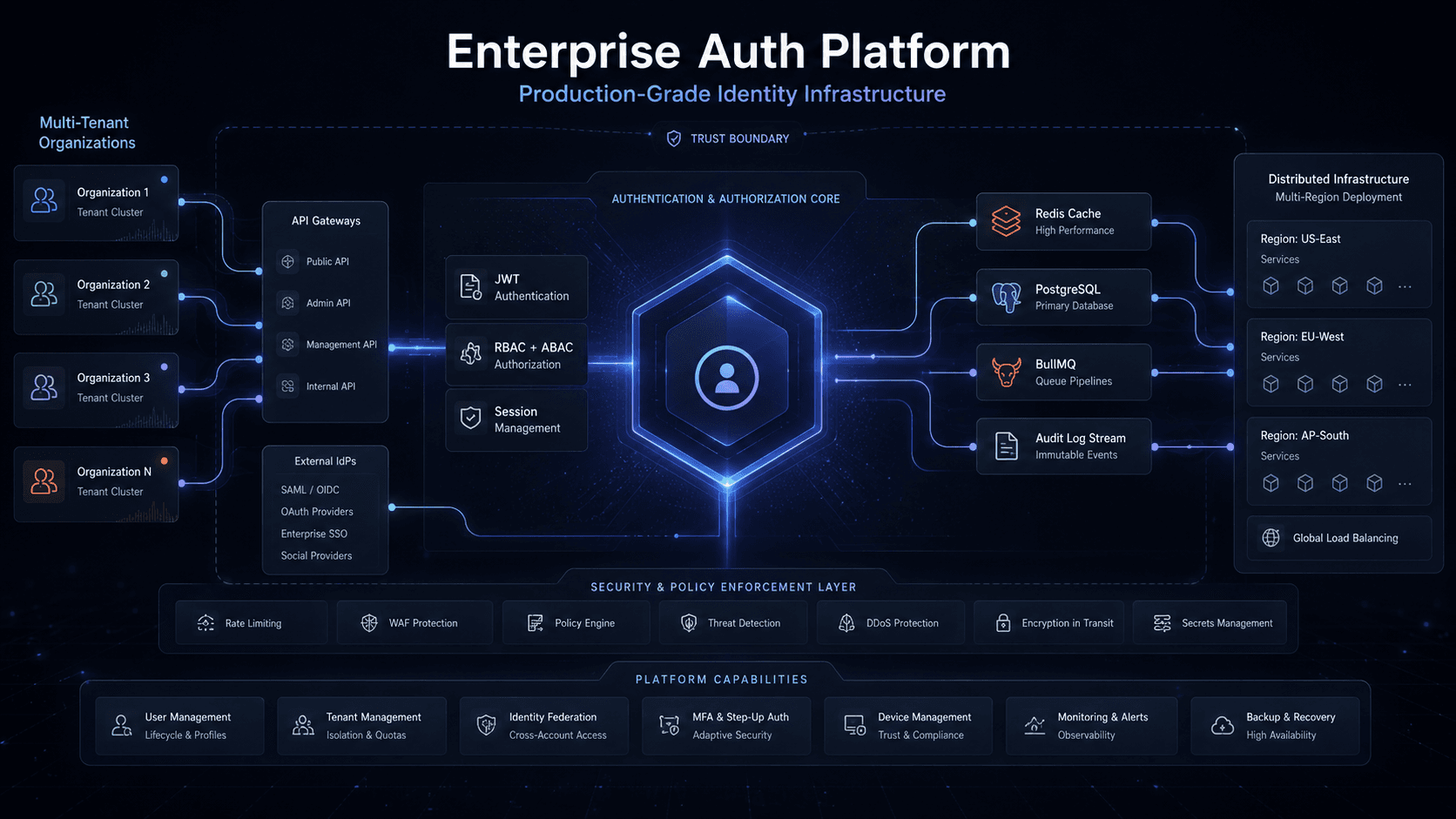
Production-grade authentication and authorization infrastructure for modern SaaS and enterprise applications — featuring multi-tenancy, RBAC + ABAC, refresh-token rotation, session management, queue-driven architecture, and tenant-scoped security.
Overview
Enterprise Auth Platform is a production-grade authentication and authorization infrastructure built for modern SaaS and enterprise applications. The platform provides a complete identity backbone with multi-tenancy, RBAC + ABAC authorization, refresh-token rotation, session management, organization isolation, queue-driven infrastructure, and production-grade security patterns. Built using NestJS 11, PostgreSQL 16, Redis 7, BullMQ, and Prisma ORM, the system is designed as a scalable foundation for SaaS products that require enterprise-level identity and access management without rebuilding authentication infrastructure from scratch. The architecture focuses on tenant isolation, policy-driven authorization, secure session handling, observability, and extensibility — allowing advanced features such as MFA, OAuth2/OIDC, SAML SSO, audit persistence, and OpenTelemetry tracing to be integrated without re-architecting the platform.
- RBAC + ABAC
- Authorization
- 4 Pipelines
- Async Infrastructure
- Token Rotation
- Session Security
- Multi-Tenant
- Architecture
Problem statement
Most authentication systems begin as simple login implementations but quickly become difficult to scale in real-world SaaS environments. As products grow, requirements expand beyond basic authentication into tenant isolation, fine-grained authorization, session revocation, auditability, invitation workflows, device management, policy enforcement, and organization-level access control. Many teams attempt to solve these concerns incrementally, leading to fragmented authorization logic, duplicated permission handling, inconsistent session management, weak revocation mechanisms, and security gaps across services. The goal of this project was to build a production-ready identity infrastructure that centralizes authentication, authorization, organization management, and security concerns into a reusable, scalable platform suitable for modern enterprise SaaS systems.
Business impact
Created a reusable enterprise identity backbone capable of supporting multi-tenant SaaS platforms, internal enterprise systems, and scalable API ecosystems. The platform delivers centralized authentication and authorization, policy-driven access control, secure refresh-token lifecycle management, organization-scoped isolation, scalable session management, queue-driven infrastructure foundations, and production-grade request tracing and logging. Designed as both a deployable authentication platform and a public reference architecture for enterprise-grade NestJS systems.
Architecture overview
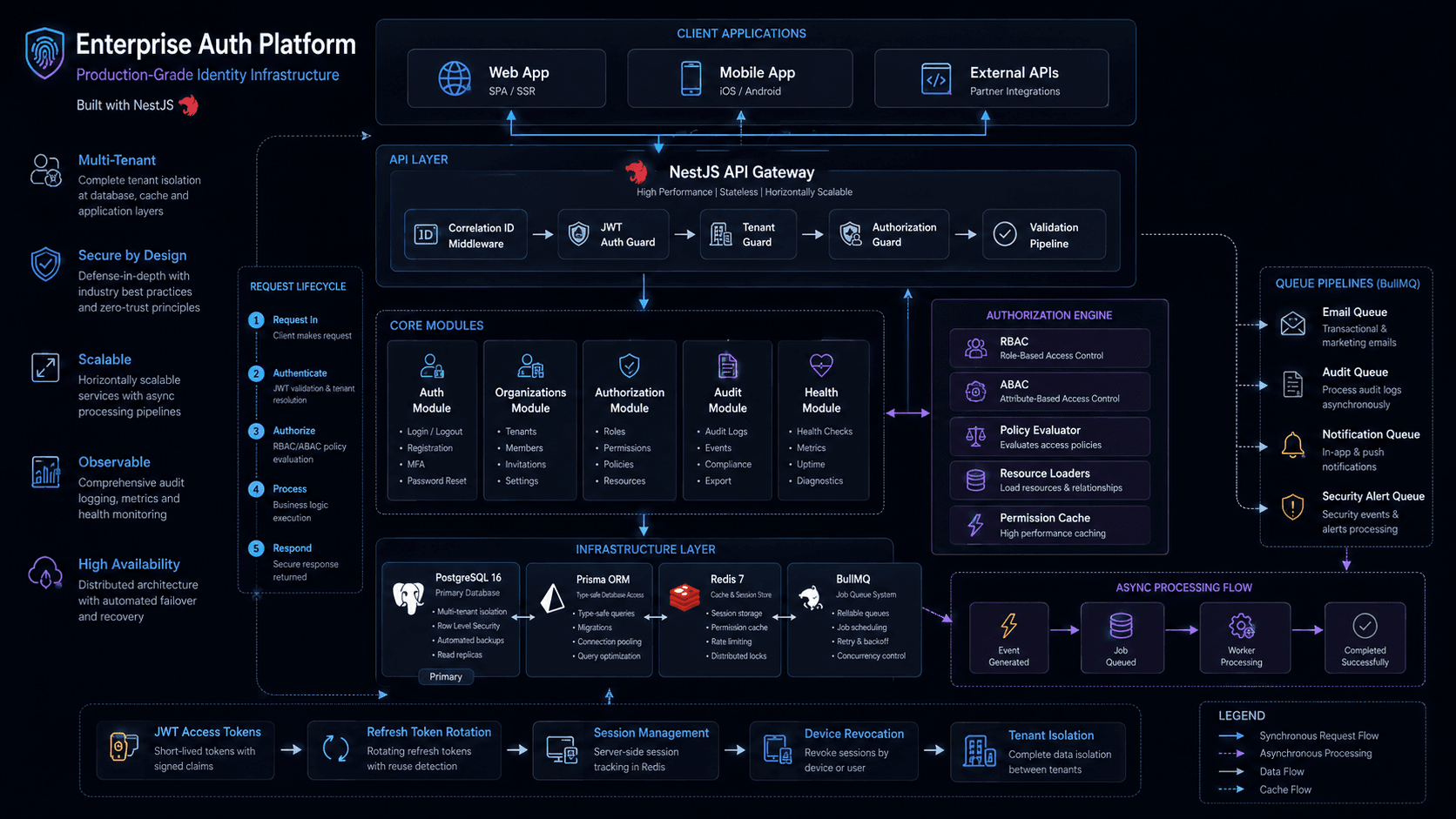
- Layered NestJS modular architecture with bounded domains
- Global request pipeline with correlation ID propagation
- JWT authentication with tenant-scoped authorization context
- Opaque refresh-token rotation with family-based reuse detection
- RBAC + ABAC hybrid authorization engine
- Redis-backed permission and attribute caching
- BullMQ-driven asynchronous infrastructure pipelines
- Structured logging with AsyncLocalStorage request context
- Centralized exception handling and response standardization
- Prisma ORM with PostgreSQL 16 and UUID v7 identifiers
- Queue-driven mail, audit, notification, and security-alert infrastructure
- Docker-based local and production-ready deployment workflow
Architecture decisions
- 01
Opaque Refresh Tokens Instead of JWT Refresh Tokens
Refresh tokens are stored as SHA-256 hashes and rotated transactionally to support secure revocation, replay detection, and token-family invalidation.
- 02
Hybrid RBAC + ABAC Authorization
RBAC handles scalable permission grouping while ABAC enables dynamic, context-aware policy evaluation using user, organization, membership, resource, and request attributes.
- 03
Tenant-Scoped JWT Context
JWT payloads include organization and membership context to enforce multi-tenant isolation consistently across services.
- 04
Modular Monolith Architecture
A modular monolith reduces operational complexity while preserving strong domain boundaries and future scalability.
- 05
Queue-Driven Infrastructure Design
BullMQ-based asynchronous processing decouples heavy infrastructure operations such as email dispatching, audit events, and security alerts from request-response flows.
Technical challenges
- Designing secure refresh-token rotation with replay attack detection
- Implementing ABAC policy evaluation with cross-source attribute comparisons
- Maintaining tenant isolation across authorization and resource loaders
- Building reusable authorization decorators and guards
- Managing permission and attribute version invalidation
- Designing scalable session and device revocation workflows
- Propagating request context globally without prop drilling
- Balancing extensibility with operational simplicity
Security
- Refresh-token reuse detection with family-wide revocation
- Tenant-scoped JWT validation and membership verification
- Role and permission version invalidation
- Configurable account lockout protection
- Email enumeration protection for password reset flows
- Centralized authorization guards and policy enforcement
- Secure password hashing with bcrypt
- Structured security event infrastructure via BullMQ
- Request correlation IDs for audit and traceability
- Input validation using DTO validation pipelines and Joi environment validation
Performance
- Redis-backed permission and attribute caching with automatic invalidation
- Optimized JWT validation pipeline with lightweight authorization context
- Asynchronous queue-driven infrastructure operations
- Bounded Redis health checks to avoid worker blocking
- Minimal request overhead using AsyncLocalStorage context propagation
- Efficient Prisma query architecture with reusable data loaders
Key features
- Multi-tenant architecture with tenant-scoped JWTs
- Hybrid RBAC + ABAC authorization engine
- Refresh-token rotation with reuse detection
- Session management and device revocation
- Organization and membership management
- Queue-driven email and audit infrastructure
- Redis-backed permission and attribute caching
- Correlation ID request tracing
- Structured logging and exception standardization
- Role, policy, and permission versioning
- Organization invitations and access workflows
- Production-ready modular NestJS architecture
Deployment approach
- Docker Compose local development workflow
- Hybrid local infrastructure workflow with PostgreSQL and Redis containers
- Production-ready Docker build pipeline
- Deployable to Railway, Render, Fly.io, ECS, and Kubernetes
- Health-check endpoint for container orchestration readiness probes
- Environment-based configuration validation with fail-fast startup
Scalability strategy
- Stateless JWT authentication architecture
- Redis-backed distributed caching strategy
- Queue-driven infrastructure for horizontal scalability
- Modular domain boundaries for future service extraction
- Version-based permission invalidation without token regeneration
- Organization-scoped authorization and resource isolation
Future scaling considerations
- MFA with TOTP and recovery code support
- OAuth2 and OpenID Connect provider integration
- SAML SSO for enterprise identity federation
- Persistent audit logging and administrative dashboards
- OpenTelemetry tracing and metrics instrumentation
- Advanced policy management UI
- Distributed event streaming infrastructure
- Multi-region deployment readiness
Engineering trade-offs
- Modular monolith architecture over microservices to reduce operational complexity
- Database-backed authorization verification over fully stateless authorization for stronger security guarantees
- Redis caching with database fallback to preserve resilience during cache outages
- Opaque refresh tokens over JWT refresh tokens for secure revocation and replay detection
- Strict authorization validation introducing additional request verification overhead for improved tenant security
Tech stack
- NestJS
- TypeScript
- PostgreSQL
- Prisma
- Redis
- BullMQ
- Docker
- JWT
- Node.js
- Pino
More case studies
Enterprise Telecom Business & Ecommerce Portal
Enterprise Angular 16 telecom platform for a Canadian telecommunications company, featuring business-side portal flows, ecommerce checkout, payment gateway integration, address lookup, SEO improvements, and Contentful-driven dynamic page and component rendering.
AppAuto AI Platform
AI-powered AppAuto platform for vehicle owners and dealerships, combining mobile garage management, VIN decoding, recalls, service history, admin analytics, and a Claude-powered text and voice assistant connected to real vehicle data.
Enterprise Membership Management SaaS Platform
Confidential enterprise multi-tenant membership management SaaS platform built with Angular, Nx monorepo, NgRx Signals, shared UI libraries, dynamic websites, programs, events, payments, reporting, permissions, and white-label tenant products.
Start a similar project
Need a similar identity & access infrastructure platform built end-to-end?
I can help plan, build, and ship a production-ready version of this type of system for your business — same engineering discipline, scoped to what you actually need.