Enterprise Telecom Business & Ecommerce Portal
Enterprise Angular 16 telecom platform for a Canadian telecommunications company, featuring business-side portal flows, ecommerce checkout, payment gateway integration, address lookup, SEO improvements, and Contentful-driven dynamic page and component rendering.
Overview
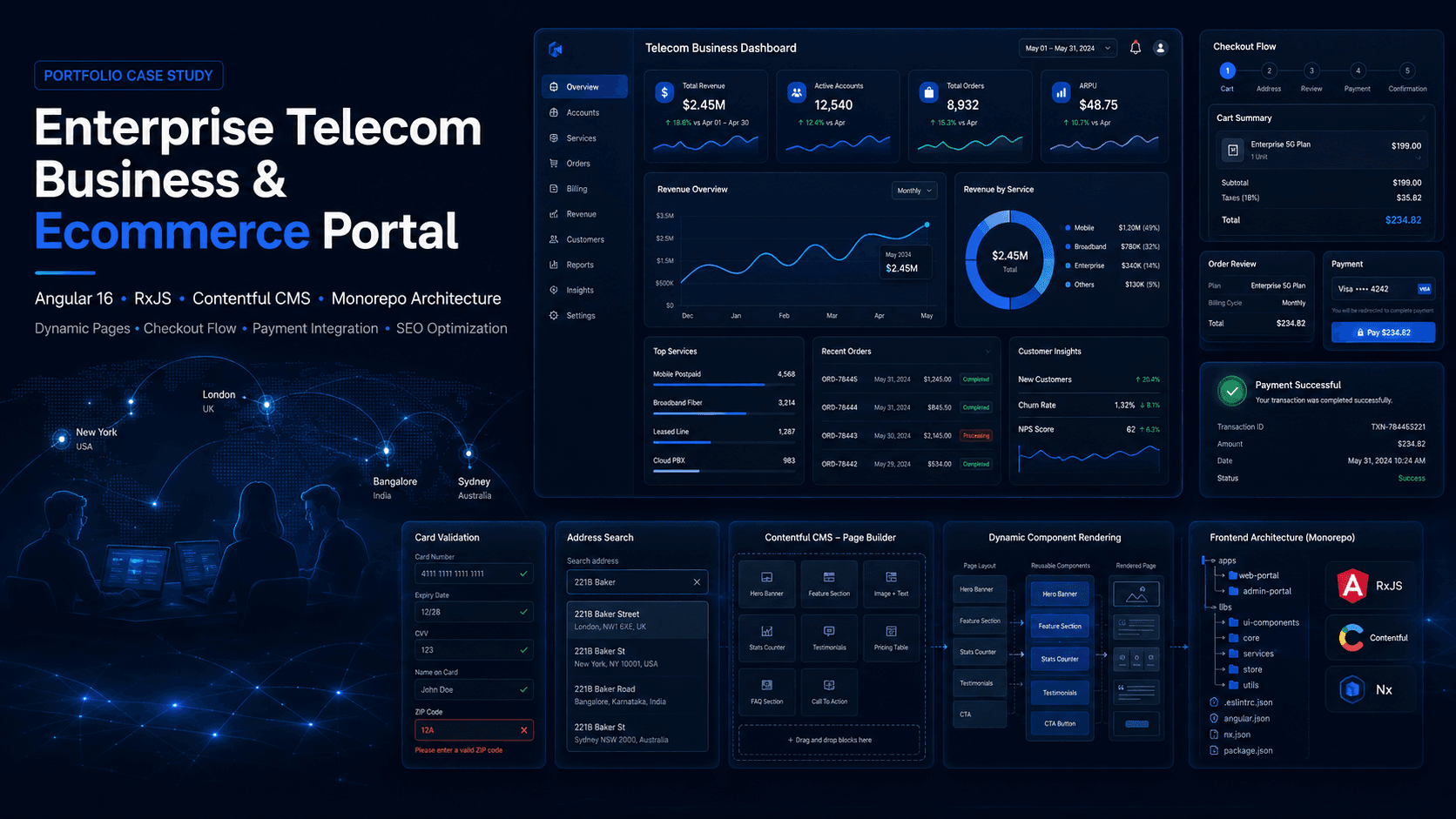
Enterprise Telecom Business & Ecommerce Portal is a large-scale Angular 16 platform built for a Canadian telecommunications company. The system supports both telecom business-side workflows and ecommerce experiences, allowing customers and business users to interact with products, services, checkout flows, dynamic content pages, and configurable forms. I worked on this project as a Senior Software Engineer / Frontend Developer, mainly responsible for the business-side menu and related frontend modules. The project was built using Angular 16, RxJS, and a professional monorepo architecture where the UI library, customer portal, and business site were managed inside a single structured codebase. A major part of the system was powered by Contentful. Pages, content sections, forms, buttons, routing, and components were dynamically rendered based on Contentful models and configuration. This made the platform highly flexible, allowing non-technical content teams to control page structure and content without requiring frontend code changes for every update. The project also included ecommerce checkout implementation, payment gateway integration, real-time address search using Google services, card validation logic, SEO fixes, metadata improvements, custom Angular pipes, reusable components, dynamic forms, and enterprise-level frontend architecture. This project gave me hands-on experience working with a global engineering team across Canada, USA, UK, India, France, Italy, and other regions. I participated in live team calls, business meetings, agile ceremonies, Jira-based delivery, code reviews, and cross-border collaboration with highly experienced engineers.
- Senior Frontend Engineer
- Role
- Angular 16
- Frontend Stack
- Monorepo
- Architecture
- Contentful
- CMS
- Global
- Team
- Telecom + Ecommerce
- Domain
Problem statement
The telecom platform needed to support complex business and ecommerce workflows while keeping the frontend flexible, scalable, and manageable across multiple teams. The main challenge was that the platform was not just a static frontend. Pages, forms, components, buttons, content blocks, routing behavior, and SEO metadata needed to be dynamically controlled through Contentful. This meant the frontend had to support configurable page rendering, dynamic component mapping, custom content models, and reusable UI patterns without breaking the user experience. The business side also required reliable checkout flows, card validation, payment transaction gateway integration, address search, dynamic forms, and clean frontend architecture that could support enterprise-level growth. Because the project was managed by a distributed international team, development also required strong communication, clean ticket handling, agile discipline, and the ability to work inside a large professional codebase.
Business impact
Contributed to a large enterprise telecom platform used for business-side operations and ecommerce customer flows. Implemented and improved key frontend modules including checkout flow, card validation, payment transaction gateway integration, Google-based address search, dynamic Contentful-driven components, dynamic routes, reusable UI components, custom Angular pipes, dynamic form rendering, SEO fixes, metadata handling, and HTML structure improvements. Helped improve delivery speed and team progress by supporting teammates, understanding the monorepo architecture quickly, and contributing consistently across complex frontend tickets. Received appreciation from the team lead and project manager for strong progress, technical ownership, team support, and the ability to work effectively in a professional global engineering environment.
Architecture overview
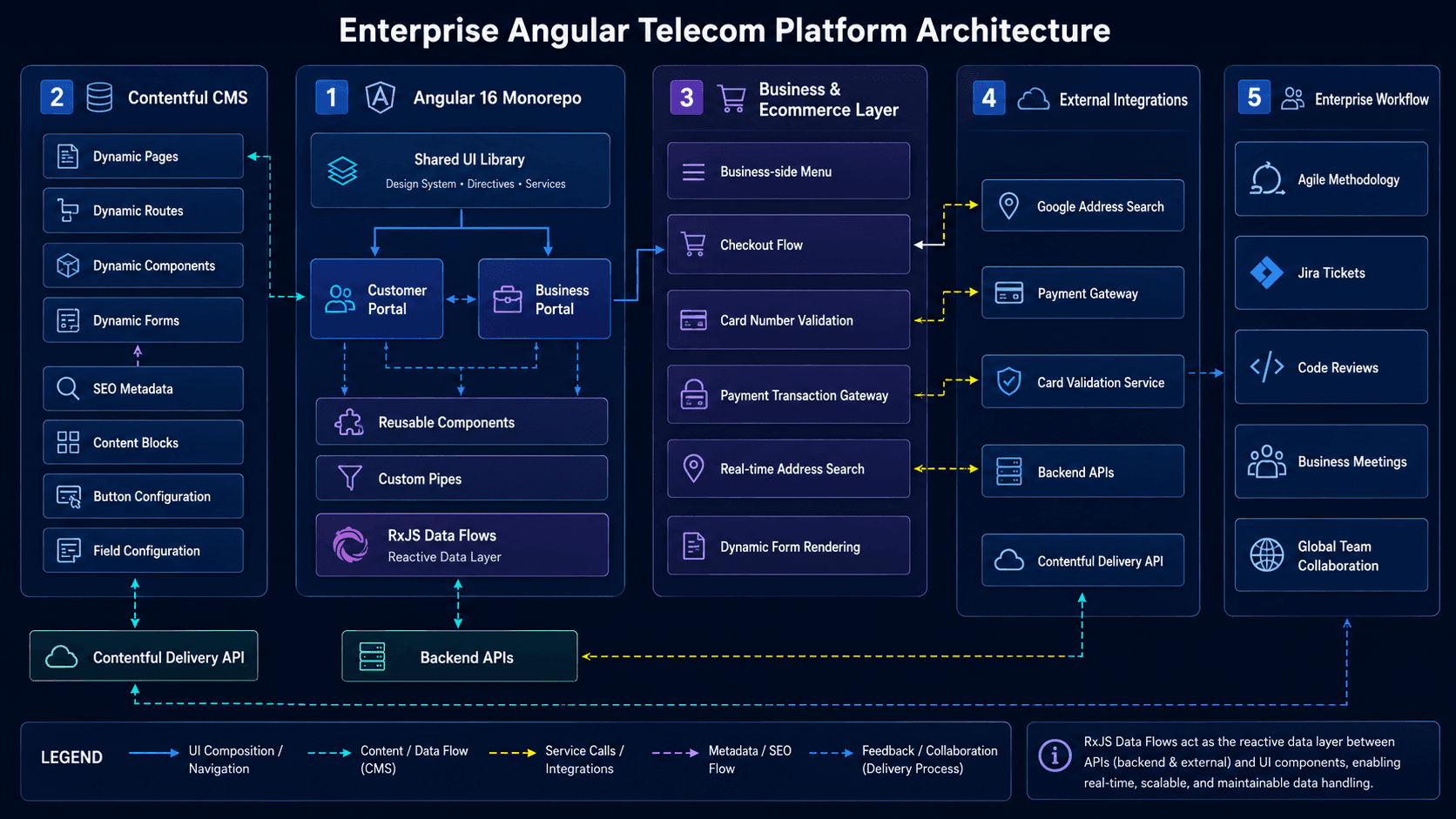
- Angular 16 frontend application using RxJS for reactive state and asynchronous data handling.
- Monorepo architecture managing multiple frontend areas in one structured codebase, including shared UI library, customer portal, and business-side site.
- Reusable UI library used across different application surfaces to keep components consistent, maintainable, and scalable.
- Contentful CMS integration for dynamic content, dynamic routing, page composition, reusable content models, component configuration, SEO metadata, and flexible page rendering.
- Dynamic component rendering system where Contentful content models decide which Angular components should be rendered on the page.
- Dynamic form rendering system where fields, buttons, loading states, and form behavior are configurable instead of being hardcoded.
- Ecommerce checkout flow with card validation, payment transaction gateway integration, address search, and business/customer journey handling.
- SEO-focused frontend improvements including metadata handling, HTML hierarchy fixes, semantic structure improvements, and page attribute corrections.
- Agile delivery workflow using Jira tickets, business meetings, sprint-based development, code reviews, team collaboration, and regular progress tracking.
Architecture decisions
- 01
Monorepo frontend architecture
The project used a monorepo structure to manage the shared UI library, customer portal, and business-side site in one professional codebase. This improved reuse, consistency, maintainability, and collaboration across teams.
- 02
Contentful-driven dynamic rendering
Instead of hardcoding every page and section, the frontend rendered pages, components, routes, forms, buttons, and content dynamically based on Contentful models. This allowed content and business teams to control page structure without requiring code changes for every update.
- 03
Reusable Angular component system
Reusable custom components, pipes, and dynamic component mappings helped keep the application clean while supporting complex page structures and business-specific UI requirements.
- 04
Reactive Angular development with RxJS
RxJS was used to manage asynchronous data flows, dynamic loading, API responses, form states, and frontend interactions in a scalable Angular application.
- 05
Enterprise ecommerce checkout flow
Checkout, card validation, payment transaction handling, and address lookup were implemented carefully because telecom ecommerce flows require accuracy, reliability, and a smooth user experience.
- 06
SEO and semantic HTML improvements
Metadata, HTML hierarchy, page attributes, and semantic structure were improved to support better search visibility, accessibility, and frontend quality.
Technical challenges
- Working inside a large Angular 16 monorepo with multiple application areas including shared UI library, customer portal, and business-side site.
- Understanding and maintaining a Contentful-driven frontend where content models controlled page structure, routes, components, forms, buttons, and metadata.
- Implementing dynamic component rendering while keeping the codebase clean, reusable, and maintainable.
- Building dynamic form rendering with configurable fields, dynamic buttons, loading states, and flexible behavior.
- Handling ecommerce checkout complexity including card validation, payment transaction gateway integration, address search, and customer journey requirements.
- Fixing SEO issues, metadata problems, HTML attribute hierarchy, and semantic frontend structure.
- Collaborating with a distributed global team across multiple countries, time zones, engineering styles, and business requirements.
- Following proper agile methodology with Jira tickets, sprint planning, team calls, business meetings, reviews, and delivery expectations.
Security
- Worked with secure frontend flows for checkout, card validation, and payment transaction gateway integration.
- Handled payment-related frontend logic carefully to validate card information and support transaction gateway communication without exposing sensitive implementation details.
- Followed enterprise frontend practices for controlled data rendering, structured API usage, and maintainable business-side workflows.
- Worked within a professional team environment where code quality, review process, ticket tracking, and production safety were important parts of delivery.
- Contentful-driven rendering was handled through structured models and controlled component mapping to avoid unsafe or unpredictable UI rendering.
Performance
- Used Angular 16 and RxJS patterns to manage dynamic data loading, asynchronous UI states, and reactive frontend behavior.
- Improved maintainability and performance by using reusable components, custom pipes, shared UI library patterns, and clean module/component structure.
- Supported dynamic loading for Contentful-driven pages, dynamic forms, buttons, and components.
- Worked on SEO and HTML hierarchy improvements that helped improve frontend quality, semantic structure, and page rendering behavior.
- The monorepo and UI library structure made it easier to share optimized components across customer and business portals.
Key features
- Angular 16 enterprise frontend development
- Business-side telecom portal implementation
- Customer ecommerce flow contributions
- Monorepo architecture with shared UI library
- RxJS-based reactive frontend handling
- Checkout flow implementation
- Card number validation integration
- Payment transaction gateway integration
- Google-based real-time address search
- Contentful CMS integration
- Dynamic routing based on CMS content
- Dynamic component rendering from Contentful models
- Dynamic form rendering
- Dynamic field rendering
- Dynamic button rendering and loading states
- Custom Angular pipes
- Reusable Angular components
- SEO issue fixes
- Metadata handling improvements
- HTML hierarchy and attribute improvements
- Agile delivery with Jira ticketing
- International team collaboration
- Business meetings and live team calls
Deployment approach
- Worked within an enterprise development workflow using agile methodology, Jira tickets, code reviews, team collaboration, business meetings, and professional release practices.
- The frontend was part of a large monorepo structure where shared UI libraries, customer portal, and business-side applications were maintained together.
- Contributions were delivered through structured tickets, proper development branches, review cycles, and coordinated team delivery.
Scalability strategy
- The project was designed to scale across multiple frontend areas through a monorepo architecture.
- Shared UI library components made it possible to reuse design patterns and reduce duplication across customer and business portals.
- Contentful-driven architecture allowed pages, forms, components, routing, buttons, and content sections to scale without requiring hardcoded frontend changes for every new page or business requirement.
- Dynamic component rendering made the application flexible enough to support future telecom pages, ecommerce flows, campaign pages, and business-side features.
- The clean Angular structure helped manage complexity even as the application grew across multiple teams and regions.
Future scaling considerations
- Expand the Contentful component mapping system to support more reusable business and ecommerce page blocks.
- Improve dynamic form rendering with stronger validation schemas, reusable field groups, and better preview support.
- Enhance SEO automation by connecting Contentful metadata models more deeply with page rendering.
- Continue improving shared UI library components for better reuse across customer portal and business-side applications.
- Introduce stronger testing coverage for dynamic components, checkout flow, address search, form rendering, and Contentful-driven routing.
- Improve frontend observability for checkout, payment, address lookup, and dynamic page rendering flows.
Engineering trade-offs
- Dynamic Contentful rendering gives content and business teams more flexibility, but it also increases frontend complexity because components, forms, buttons, routes, and metadata must be mapped carefully.
- A monorepo architecture improves reuse and consistency, but it requires strong structure, naming discipline, and team coordination to avoid confusion across multiple applications.
- Dynamic form rendering reduces hardcoded frontend work, but it requires careful validation, loading-state handling, and reusable field configuration.
- Enterprise checkout and payment flows require more careful implementation than normal UI screens because small mistakes can affect customer trust and business transactions.
- Working with a global team improves engineering exposure and professional growth, but it also requires strong communication, ticket clarity, and disciplined collaboration across time zones.
Tech stack
- Angular 16
- RxJS
- TypeScript
- JavaScript
- HTML
- SCSS
- Contentful CMS
- Google Address Search
- Payment Gateway Integration
- Card Validation
- Monorepo Architecture
- Shared UI Library
- Dynamic Component Rendering
- Dynamic Form Rendering
- SEO Optimization
- Jira
- Agile Methodology
More case studies
Enterprise Auth Platform
Production-grade authentication and authorization infrastructure for modern SaaS and enterprise applications — featuring multi-tenancy, RBAC + ABAC, refresh-token rotation, session management, queue-driven architecture, and tenant-scoped security.
AppAuto AI Platform
AI-powered AppAuto platform for vehicle owners and dealerships, combining mobile garage management, VIN decoding, recalls, service history, admin analytics, and a Claude-powered text and voice assistant connected to real vehicle data.
Enterprise Membership Management SaaS Platform
Confidential enterprise multi-tenant membership management SaaS platform built with Angular, Nx monorepo, NgRx Signals, shared UI libraries, dynamic websites, programs, events, payments, reporting, permissions, and white-label tenant products.
Start a similar project
Need a similar enterprise frontend platform platform built end-to-end?
I can help plan, build, and ship a production-ready version of this type of system for your business — same engineering discipline, scoped to what you actually need.