How to Plan MVP, Scalable, and Enterprise Versions of a Product
The same product idea can be built in different ways: MVP, scalable, or enterprise-grade. Each version has a different scope, architecture, timeline, budget, and risk level. This article explains how to plan the right version based on business goals, product stage, and future growth.
- #mvp-planning
- #scalable-software
- #enterprise-software
- #product-architecture
- #saas-development
- #software-estimation
- #startup-development
- #system-design
- #backend-architecture
- #software-project-planning
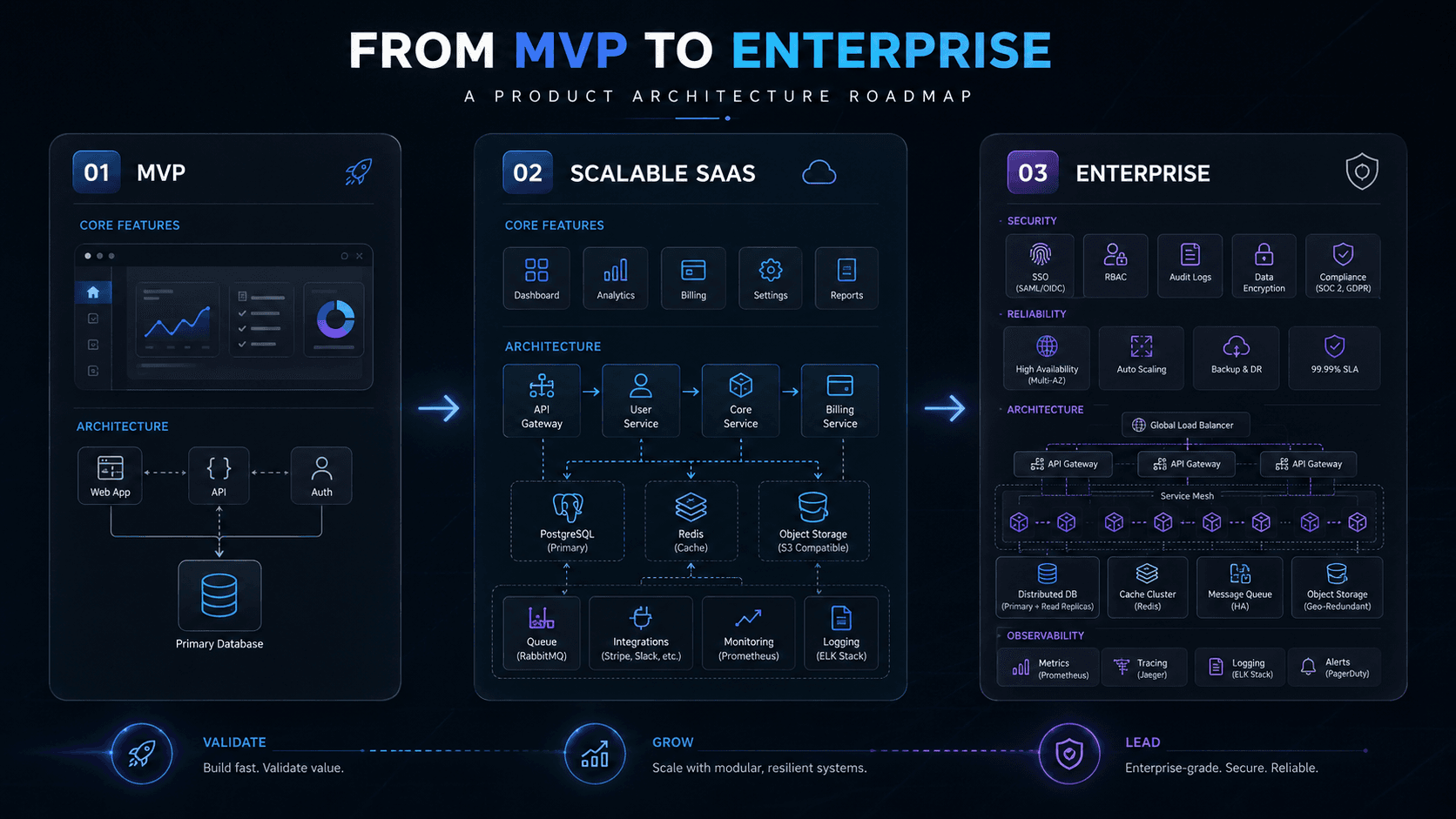
How to Plan MVP, Scalable, and Enterprise Versions of a Product
One of the most important things in software planning is understanding that the same product idea can be built in different ways.
A client may say:
“I want to build a SaaS platform.”
But that sentence is not enough to estimate the project properly.
The real question is:
“What version of the product do you want to build right now?”
Because one product can have multiple levels:
MVP version
scalable version
enterprise version
Each version has a different purpose, feature depth, architecture, timeline, budget, and technical risk.
An MVP is not the same as a scalable SaaS product.
A scalable SaaS product is not the same as an enterprise-grade platform.
This difference matters because many project misunderstandings happen when the client expects enterprise-level reliability but asks for MVP-level cost and timeline.
A good software plan should clearly define which version is being built and why.
Why Product Version Planning Matters
Product version planning helps both the client and development team understand the real scope.
Without version planning, the project becomes unclear.
The client may expect advanced permissions, reporting, integrations, security, automation, audit logs, and admin controls.
The developer may estimate only basic screens, CRUD operations, and simple login.
This creates mismatch.
Later, both sides feel frustrated.
The client feels the product is incomplete.
The developer feels the scope increased.
Version planning solves this problem by separating what should be built now from what should come later.
It helps answer:
What is required for validation?
What is required for real users?
What is required for growth?
What is required for enterprise customers?
What can be delayed?
What should be planned from day one?
What technical foundation should not be compromised?
This makes the project more realistic and professional.
MVP Version: Build to Validate
The MVP version is the smallest useful version of the product.
Its goal is not to build everything.
Its goal is to validate the idea.
An MVP should answer:
Does the product solve a real problem?
Will users use it?
Is the core workflow valuable?
Can the business model work?
What feedback do users give?
What should be improved before scaling?
A good MVP is focused.
It includes only the features needed to test the product in the real world.
For example, a SaaS MVP may include:
user registration login main dashboard core business workflow basic admin panel basic notifications simple reports basic deployment
It may not include:
advanced analytics complex automation enterprise permissions white-label features multi-region infrastructure advanced audit logs custom billing rules deep third-party integrations
The MVP should be simple, but it should not be careless.
That is the key point.
MVP Does Not Mean Low-Quality Code
Many people confuse MVP with low-quality development.
They think MVP means:
“Build it quickly, no need to think too much.”
That is a dangerous approach.
MVP means limited scope, not poor quality.
A proper MVP should still have:
clean code structure
secure authentication
reasonable database design
clear API structure
basic validation
basic error handling
simple deployment
maintainable architecture
The MVP does not need enterprise-level infrastructure, but it should not block future growth.
If the MVP is built in a messy way, the next version becomes expensive.
The business may need to rewrite the product before scaling.
That defeats the purpose of an MVP.
Scalable Version: Build to Grow
A scalable version is for products that are moving beyond basic validation.
At this stage, the product may have real users, growing data, more features, integrations, internal teams, and operational needs.
The goal is no longer only validation.
The goal is reliable growth.
A scalable version usually includes stronger planning around:
modular architecture
database relationships
roles and permissions
organization/team structure
background jobs
caching
file storage
integrations
reporting
admin operations
deployment pipeline
monitoring and logging
For example, a scalable SaaS version may include:
multi-role access team or organization management subscription-ready structure queue-based background jobs email and notification system webhook processing API versioning structured logging error tracking database indexing scalable deployment
This version requires more planning than an MVP because the product is expected to support more users and more business operations.
Enterprise Version: Build for Trust and Control
An enterprise version is built for organizations that need stronger security, reliability, compliance readiness, auditability, and operational control.
Enterprise products are not only about features.
They are about trust.
An enterprise customer may ask:
Is the system secure?
Can access be controlled properly?
Can actions be audited?
Can data be isolated?
Can the system handle scale?
Can downtime be minimized?
Can the system integrate with existing tools?
Can admins manage users and permissions?
Can reports be trusted?
Can security incidents be investigated?
An enterprise version may include:
advanced RBAC and ABAC audit logs SSO readiness multi-factor authentication organization-level policies advanced admin controls data retention rules backup strategy monitoring and alerting high-availability deployment compliance-focused logging role-based approval flows security hardening infrastructure as code
This level takes more time and budget because the system must be designed for long-term reliability.
Enterprise software is not just built to work.
It is built to be trusted.
The Same Feature Has Different Depth
One of the best ways to understand product versions is to look at the same feature across MVP, scalable, and enterprise levels.
For example, take authentication.
In an MVP, authentication may include:
email/password login password reset basic protected routes simple user profile
In a scalable version, authentication may include:
refresh token handling session tracking role-based access organization membership secure token storage logout from all devices
In an enterprise version, authentication may include:
MFA SSO readiness audit logs token versioning session revocation device management organization policies security event tracking
The feature name is the same: authentication.
But the implementation depth is different.
This is why project pricing cannot be based only on feature names.
The depth of each feature matters.
Example: Admin Panel Across Three Versions
An admin panel can also be very different depending on the product version.
MVP admin panel:
view users manage basic records change simple statuses view basic dashboard
Scalable admin panel:
manage users and roles manage teams or organizations view reports handle support cases manage notifications filter and export data
Enterprise admin panel:
advanced role management audit trails admin activity logs permission policies approval workflows data access controls system health monitoring organization-level configuration
Again, the feature is called “admin panel,” but the actual scope is completely different.
This is why version planning is important.
Example: Notifications Across Three Versions
Notifications can also be simple or advanced.
MVP notifications:
basic email notification simple in-app alert manual status update
Scalable notifications:
email queue notification preferences retry handling multiple notification types admin-triggered notifications
Enterprise notifications:
multi-channel notification engine event-based triggers audit logging delivery tracking user-level preferences organization-level policies failure monitoring
The more serious the product becomes, the more depth each feature needs.
Example: Reporting Across Three Versions
Reporting is another area where scope can grow quickly.
MVP reports:
basic dashboard cards simple count summaries limited filters
Scalable reports:
date filters export options role-based report access business KPIs database query optimization
Enterprise reports:
custom reports audit-ready exports scheduled reports large data processing advanced analytics permission-scoped data views report generation queues
This shows why “reports” should not be estimated as one simple item without understanding the expected depth.
MVP, Scalable, and Enterprise Comparison
Here is a simple comparison.
Area | MVP Version | Scalable Version | Enterprise Version |
Goal | Validate idea | Support growth | Support trust, control, and reliability |
Scope | Core features only | Core + growth features | Advanced operational features |
Architecture | Simple but clean | Modular and scalable | Secure, auditable, and resilient |
Users | Early users | Growing user base | Teams, organizations, enterprises |
Auth | Basic secure login | Sessions, roles, permissions | MFA, SSO, audit logs, policies |
Database | Simple structured schema | Optimized relationships and indexes | Data isolation, retention, auditability |
Integrations | Required only | Multiple integrations | Reliable, monitored, policy-controlled |
Deployment | Basic production deployment | Staging + production pipeline | High-availability and monitored deployment |
Monitoring | Basic logs | Error tracking and structured logs | Observability, alerts, audit trails |
Cost | Lower | Medium to high | Highest |
Timeline | Fastest | Longer | Longest |
This comparison helps clients understand why the same idea can have different development plans.
How I Decide Which Version a Client Needs
To decide the right product version, I usually ask questions like:
Is this product for validation or real operations?
Are users already waiting for it?
Is the business model already proven?
Will the system handle sensitive data?
Does the product need teams or organizations?
Will the product need payments or subscriptions?
Are enterprise customers expected?
Does the product need audit logs?
Are integrations required?
What happens if the system goes down?
What is the available budget?
What is the expected launch timeline?
What features can wait?
The answers help decide whether the project should start as MVP, scalable, or enterprise.
When to Choose MVP
Choose an MVP when:
the idea is new
the market is not validated yet
the budget is limited
the goal is to test quickly
only core workflows are needed
the product may change after feedback
the first users are small in number
MVP is best when speed and learning are more important than advanced functionality.
But even then, the foundation should be clean enough to continue.
When to Choose a Scalable Version
Choose a scalable version when:
the idea is already validated
real users will depend on the system
the product needs multiple roles
integrations are required
data will grow over time
the business needs reporting
the product will continue for years
the team wants to avoid rebuilding soon
This is the best choice for many serious SaaS products.
It balances speed with long-term maintainability.
When to Choose an Enterprise Version
Choose an enterprise version when:
the product handles sensitive data
large teams or organizations will use it
security is a major concern
audit logs are required
compliance may be required
uptime matters
admin control is important
the product will be used by business customers
integrations are business-critical
long-term reliability is more important than fastest launch
Enterprise products need more planning because mistakes are more expensive.
What Should Be Planned from Day One?
Even if the client chooses an MVP, some things should still be planned early.
These include:
user model
database structure
authentication
authorization direction
ownership of data
admin access
deployment approach
future feature direction
integration possibility
security basics
This does not mean building everything from day one.
It means avoiding decisions that block future growth.
For example, if a product may later support organizations, it is smart to consider that in the database design early.
If a product may later need roles, it is smart not to hardcode everything around one user type.
Good planning protects the future without overbuilding the present.
What Can Usually Wait?
Some features can usually wait until the product is validated.
Examples include:
advanced analytics
complex automation
white-label controls
enterprise SSO
advanced audit exports
complex billing rules
custom report builder
multi-region deployment
complex DevOps pipeline
AI automation
advanced permission policies
These features can be expensive.
If they are not required for launch, they can be planned for later phases.
This keeps the first version focused and affordable.
Avoiding Over-Engineering
Planning for future growth does not mean over-engineering.
Over-engineering happens when the product includes too much complexity before it is needed.
For example, an early MVP may not need:
microservices
Kubernetes
event sourcing
complex CQRS
multi-region infrastructure
advanced policy engines
full enterprise analytics
These things may be useful later, but adding them too early can slow down the product.
Good architecture is not about using the most complex tools.
Good architecture is about making the right decisions for the product stage.
Avoiding Under-Engineering
Under-engineering is the opposite problem.
It happens when the product is built too cheaply or too quickly without considering basic future needs.
Examples include:
no proper database relationships
hardcoded user roles
no validation
no backend structure
no error handling
no logs
weak authentication
no admin control
no deployment planning
no scalability direction
Under-engineering may save money at the start, but it often creates expensive rebuilds later.
The best plan avoids both extremes.
Do not over-engineer.
Do not under-engineer.
Build the right level for the current stage.
How This Helps with Estimation
Version planning makes estimation more accurate.
Instead of asking:
“How much will this app cost?”
A better discussion is:
“Which version are we building first?”
For example:
Plan 1: MVP version Plan 2: Scalable version Plan 3: Enterprise version
Each plan can include the same product idea but different implementation depth.
This helps the client choose based on budget, timeline, and business goals.
It also helps the development team explain why one version costs more than another.
The difference is not only number of screens.
The difference is architecture, reliability, security, scalability, testing, integrations, and maintainability.
A Practical Example
Imagine a client wants to build a learning management platform.
MVP version may include:
student login course list video lessons basic quiz admin course management progress tracking
Scalable version may include:
multiple organizations trainer roles course assignments certificate generation notifications reporting dashboard background processing integration-ready architecture
Enterprise version may include:
company-level tenant isolation advanced permissions audit logs AI-assisted training feedback SSO readiness compliance reporting device/session tracking large-scale content management observability and monitoring
All three are LMS products.
But they are not the same project.
This is why planning product versions matters.
Final Thoughts
Every software product should not be built the same way.
A new idea needs an MVP.
A growing product needs scalable architecture.
A serious business platform needs enterprise-level reliability, security, and control.
The mistake is not choosing MVP, scalable, or enterprise.
The mistake is not knowing which one you are building.
A good product plan defines the version clearly before development starts.
That clarity helps with scope, budget, timeline, architecture, and expectations.
The best software teams do not only write code.
They help clients choose the right version of the product for the right stage of the business.
Build the MVP when you need validation.
Build the scalable version when you need growth.
Build the enterprise version when you need trust, security, and long-term control.
Frequently asked questions
- What is the difference between MVP, scalable, and enterprise software?
- An MVP is built to validate the core idea with limited features. A scalable version is built to support growth, real users, integrations, and maintainability. An enterprise version is built for security, reliability, auditability, compliance readiness, and long-term operations.
- Should an MVP be scalable from day one?
- An MVP should not be over-engineered, but it should have a clean foundation. The goal is to keep the scope small while avoiding technical decisions that force a rebuild later.
- Why does an enterprise version cost more than an MVP?
- Enterprise software requires deeper security, access control, audit logs, monitoring, reliability, admin controls, integrations, testing, and infrastructure planning. The cost is higher because the risk and quality expectations are higher.
- Can the same product start as an MVP and become enterprise later?
- Yes, but only if the MVP is planned properly. The first version does not need every enterprise feature, but the foundation should not block future roles, permissions, data isolation, integrations, and security improvements.
- How do I know which version of my product to build first?
- Choose MVP if the idea needs validation, scalable if users and operations are growing, and enterprise if security, reliability, compliance, and organizational control are required from the start.