From MVP to Scalable SaaS: What I Plan Before Writing Code
Building a SaaS product is not only about writing code quickly. Before development starts, the right planning around users, roles, database design, architecture, security, scalability, and future features can save months of rework later.
- #saas
- #mvp-development
- #software-architecture
- #startup-development
- #product-engineering
- #scalable-saas
- #backend-architecture
- #system-design
- #project-planning
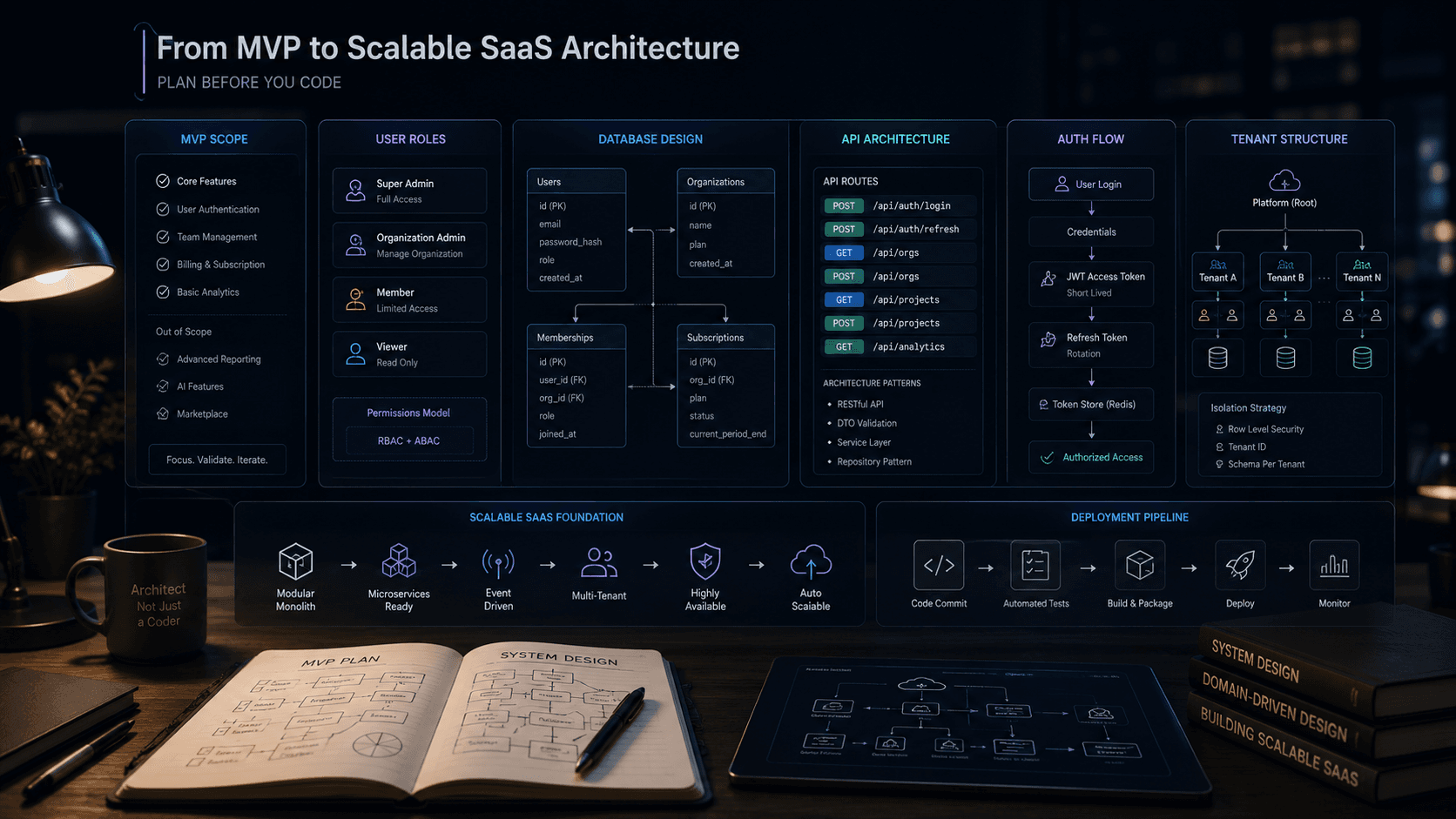
From MVP to Scalable SaaS: What I Plan Before Writing Code
Many software projects fail before the first line of code is written.
Not because the idea is bad.
Not because the developers are not skilled.
But because the product was not planned properly before development started.
This is especially true for SaaS products. A SaaS platform is not just a website with login and dashboards. It usually grows into a system with users, teams, organizations, subscriptions, permissions, notifications, integrations, reporting, automation, and admin operations.
If these things are not considered early, the product may work in the beginning but become painful to scale later.
That is why before writing code, I always try to understand the product from three angles:
What should be built now? What should be prepared for later? What should be avoided to keep the MVP fast and focused?
A good MVP does not mean building everything. It means building the smallest reliable version of the product with a foundation that does not block future growth.
MVP Does Not Mean Random Development
MVP stands for Minimum Viable Product.
But many people misunderstand it.
They think MVP means:
“Build the cheapest and quickest version possible.”
That approach usually creates problems later.
A better definition is:
“Build the smallest version that solves the core problem and validates the business idea.”
That means the MVP should be small, but it still needs structure.
For example, if a SaaS product will eventually support teams, organizations, roles, subscriptions, or multiple user types, the MVP does not need every advanced feature on day one. But the database and backend should not be designed in a way that makes those features impossible later.
A good MVP should be:
focused
usable
maintainable
secure enough for real users
flexible enough for the next phase
The goal is not to over-engineer. The goal is to avoid building yourself into a corner.
First, I Understand the Business Problem
Before thinking about technology, I first try to understand the business problem.
The most important questions are:
What problem does this product solve?
Who will use it?
Why will they use it?
What is the main workflow?
What action should the user complete successfully?
What result does the business expect from the product?
Without this clarity, development becomes feature-based instead of problem-based.
A SaaS product should not start with random screens. It should start with the core workflow.
For example:
A CRM should help teams manage leads and follow-ups.
A booking platform should help users reserve services smoothly.
A fleet system should help managers track vehicles, safety, and complaints.
An AI assistant should help users complete tasks faster, not just chat.
An authentication platform should help products manage identity, access, and security.
When the business problem is clear, the MVP becomes easier to define.
Then I Separate Core Features from Future Features
One of the biggest mistakes in SaaS planning is trying to build everything in version one.
This makes the product expensive, slow, and harder to launch.
Before development, I separate features into three groups:
Must-have features These are required for the product to work.
Should-have features These are useful but can be added after the MVP.
Future features These are important for growth but not needed for initial validation.
For example, a SaaS MVP may need:
user registration
login
main dashboard
core business workflow
basic admin panel
basic notifications
essential reports
But it may not need advanced analytics, complex automation, white-label settings, enterprise permissions, multiple billing tiers, or AI workflows in the first release.
This separation helps protect the budget and timeline.
But even when future features are not built, they should be considered during architecture planning.
That is the important difference.
I Plan User Roles and Permissions Early
Most SaaS products have more than one type of user.
For example:
owner
admin
manager
employee
customer
support user
super admin
If roles and permissions are not planned early, the system often ends up with hardcoded conditions like:
if user is admin, show this button if user is manager, allow this action if user is owner, show this page
This may work in the beginning, but it becomes messy as the product grows.
Before writing code, I plan:
who can access the platform
what each user type can see
what each user type can create, update, or delete
which actions need approval
which data should be private
which data should be shared within a team or organization
For SaaS products, permissions are not just a technical feature. They directly affect security, user experience, and business operations.
Even if the MVP starts with simple roles, the system should be designed in a way that allows better access control later.
I Decide Whether the Product Needs Multi-Tenancy
Multi-tenancy is one of the most important SaaS architecture decisions.
In simple words, multi-tenancy means one software platform serves multiple customers, companies, teams, or organizations while keeping their data separated.
Before development, I ask:
Will each company have its own workspace?
Will users belong to an organization or team?
Can one user belong to multiple organizations?
Should data be isolated by tenant?
Will admins manage users inside their own organization?
Will there be organization-level settings?
Will billing be connected to an organization or an individual user?
These questions are important because multi-tenancy affects the database, authentication, authorization, APIs, admin panel, billing, and reporting.
If a SaaS product needs multi-tenancy but it is not planned from the start, adding it later can be very expensive.
The MVP does not need advanced tenant features, but the foundation should understand ownership and data isolation.
I Think About the Database Before the UI
Many people start software planning from UI screens.
UI is important, but for SaaS products, the database is usually more important.
A poor UI can be improved later. A poor database structure can break the whole system.
Before writing code, I think about:
main entities
relationships between entities
ownership of records
user and organization structure
audit/history requirements
reporting needs
search and filtering requirements
future integrations
data privacy
soft deletes
status flows
For example, if you are building a project management SaaS, you need to understand how users, teams, projects, tasks, comments, attachments, notifications, and activity logs connect.
If this is not planned correctly, future features become difficult.
A good database does not need to be complex. But it should match the real business model.
I Plan Authentication and Authorization Properly
Authentication answers:
Who is the user?
Authorization answers:
What is the user allowed to do?
Both are important in SaaS products.
Before writing code, I plan:
login method
registration flow
password reset
email verification
session handling
token strategy
refresh token behavior
role-based access
organization-level access
protected routes
API guards
admin access
account status
For an MVP, authentication can be simple. But it should not be weak.
If authentication is poorly implemented, it affects the whole system. Later, when you need roles, teams, permissions, security controls, or enterprise access, the old structure may not support it.
That is why I prefer planning identity and access early, especially for SaaS products.
I Define the Backend Architecture
The backend is where most SaaS complexity lives.
Before writing code, I plan how the backend should be structured.
Important questions include:
Should the product start as a modular monolith?
What are the main modules?
Where should business logic live?
How should APIs be organized?
How should errors be handled?
How should validation work?
How should logs be generated?
How should background jobs be handled?
How should third-party integrations be separated?
How should the system be tested?
For most MVPs, a clean modular monolith is better than microservices.
Microservices can be useful at the right stage, but starting with them too early usually increases complexity. A modular monolith keeps development faster while still allowing clean separation between features.
For example, a SaaS backend may include modules like:
auth
users
organizations
billing
notifications
files
reports
integrations
admin
This structure helps the product grow without turning the codebase into a mess.
I Plan API Design Before Building Screens
Frontend screens depend on APIs.
If APIs are not planned well, the frontend becomes difficult to maintain.
Before implementation, I think about:
API naming
request/response structure
pagination
filtering
sorting
validation errors
authentication errors
permission errors
status codes
file uploads
bulk actions
dashboard data
mobile app usage if needed
A good API should be predictable.
For example, if one endpoint returns userId, another returns user_id, and another returns nested user data in a completely different shape, the frontend becomes messy.
Consistent APIs save time for both frontend and backend development.
They also make future mobile apps, integrations, and public APIs easier to build.
I Decide What Should Be Real-Time and What Should Be Async
Not every task should happen immediately inside the main user request.
Some tasks should be handled in the background.
Before writing code, I identify which actions may need queues or background jobs.
Examples include:
sending emails
processing uploaded files
generating reports
syncing third-party data
sending notifications
processing payments
running AI workflows
importing large CSV files
webhook handling
If these actions are handled directly in the request, the app may become slow or unstable.
For MVPs, not every background system needs to be advanced. But it is still useful to know which workflows may later need queues like Redis and BullMQ.
This makes the architecture easier to scale when needed.
I Think About Integrations Early
Modern SaaS products often integrate with external services.
These may include:
payment gateways
email providers
SMS services
AI models
CRMs
accounting tools
calendars
file storage
analytics
third-party APIs
Before coding, I ask:
Which integrations are required for MVP?
Which integrations can come later?
Are webhooks involved?
What happens if the third-party service fails?
Do we need retry logic?
Do we need logs for failed requests?
Do we need to store external IDs?
Do we need background sync?
Integrations should not be added randomly.
A good integration plan prevents future problems like duplicate records, failed payments, missing emails, broken webhooks, or inconsistent data.
I Plan the Admin Side
Many SaaS products focus only on the user-facing side and forget the admin side.
But every real product needs some level of internal control.
Before development, I plan:
who manages users
who manages organizations
who views reports
who handles support issues
who can change statuses
who can view logs or history
who can manage subscriptions
who can update platform settings
Even if the admin panel is simple in the MVP, it should cover the most important operational needs.
Without an admin side, the business team may become dependent on developers for small data changes and support tasks.
That creates unnecessary operational cost.
I Plan Basic Observability
Observability means understanding what is happening inside the system.
For an MVP, this does not need to be complex. But basic visibility is important.
Before writing code, I consider:
error logging
request tracing
important business events
failed login attempts
failed payments
failed background jobs
API performance
database errors
user activity where needed
Without logs, debugging becomes guesswork.
When a user says, “Something is not working,” the team should be able to check what happened.
Good logs save hours of debugging and make the system easier to maintain.
I Plan Deployment and Environments
Development is not complete until the product can run reliably.
Before writing code, I think about deployment early.
Important questions include:
Where will the frontend be hosted?
Where will the backend be deployed?
Which database will be used?
Do we need staging and production environments?
How will environment variables be managed?
How will migrations run?
How will files be stored?
How will backups work?
How will SSL and domains be configured?
How will errors be monitored?
A product that only works on a developer’s laptop is not production-ready.
Even for MVPs, deployment planning matters.
I Avoid Over-Engineering
Planning for scale does not mean over-engineering.
This is very important.
A startup MVP does not need the same architecture as a large enterprise platform.
Not every product needs:
microservices
Kubernetes
event sourcing
complex CQRS
advanced caching
enterprise permissions
multi-region infrastructure
heavy DevOps pipelines
Adding too much complexity too early can slow the product down.
The goal is to build a foundation that is clean and scalable enough for the next stage.
Good architecture should support growth without making the MVP heavy.
I Plan the Product in Phases
A SaaS product should usually be planned in phases.
For example:
Phase 1: MVP
core user flow
basic authentication
main dashboard
essential CRUD features
simple admin controls
basic deployment
Phase 2: Scalable Product
improved roles and permissions
better reporting
billing/subscriptions
background jobs
notifications
integrations
performance improvements
Phase 3: Enterprise-Ready Product
advanced audit logs
organization-level settings
SSO if needed
advanced security
advanced permissions
usage analytics
compliance-focused features
stronger infrastructure
This phased approach helps control cost while still protecting the future.
It also helps clients understand what should be built now and what should come later.
What I Usually Document Before Development
Before starting development, I prefer having a clear plan for:
product goal
user roles
core workflows
MVP feature list
future feature list
database entities
API structure
authentication flow
authorization rules
third-party integrations
admin requirements
deployment plan
timeline and priorities
This does not always need to be a huge document.
For small projects, it can be simple.
For serious SaaS products, it should be more detailed.
The purpose is to create clarity before development starts.
A Practical Example
Imagine a client wants to build a SaaS platform for managing service bookings.
A weak planning approach would start directly with screens:
login page
dashboard
booking form
profile page
That may look fast, but it misses important product questions.
A better planning approach asks:
Is this for one business or multiple businesses?
Can each business have its own staff?
Can customers book services online?
Are there roles like owner, manager, staff, and customer?
Will payments be added later?
Will reminders be sent by email or SMS?
Will there be cancellation rules?
Will there be reports?
Will the product need subscription plans?
Will the system support multiple locations?
These answers affect the database, backend, frontend, and future architecture.
That is why planning matters.
Final Thoughts
Writing code is not the first step of building a SaaS product.
The first step is understanding what the product needs to become.
A good MVP should be small, focused, and fast to launch. But it should also be built on a foundation that can support the next version.
Before writing code, I plan the product scope, user roles, database structure, authentication, authorization, backend modules, APIs, integrations, admin needs, deployment, and future scaling path.
This planning does not slow the product down.
It prevents expensive mistakes.
A scalable SaaS product is not created by adding complexity from day one. It is created by making the right early decisions, avoiding dangerous shortcuts, and building a clean foundation that can grow with the business.
Build small.
Build clearly.
Build with the future in mind.
Frequently asked questions
- Is a modular monolith good for SaaS MVPs?
- Yes. For most SaaS MVPs, a modular monolith is a strong starting point because it keeps development simple while still separating business domains clearly for future growth.
- What should be planned before building a SaaS MVP?
- Before building a SaaS MVP, you should plan the core problem, user roles, feature scope, database structure, authentication, authorization, APIs, integrations, admin needs, deployment, and future scaling path.
- Should an MVP be scalable from day one?
- An MVP should not be over-engineered, but it should have a clean foundation. It should support future growth without requiring a full rebuild after the product starts getting users.
- What is the biggest mistake in SaaS MVP development?
- The biggest mistake is building screens quickly without planning the backend, database, user roles, permissions, and future product structure. This usually creates technical debt and expensive rework later.