Why Project Structure and Design Patterns Matter in Scalable Software
Scalable software is not only about servers, databases, or cloud infrastructure. It also depends on how the codebase is structured. A clean project structure and the right design patterns make software easier to maintain, extend, test, debug, and scale as the product and team grow.
- #project-structure
- #design-patterns
- #software-architecture
- #scalable-software
- #backend-architecture
- #clean-architecture
- #nestjs
- #nextjs
- #system-design
- #maintainable-code
- #enterprise-software
- #saas-development
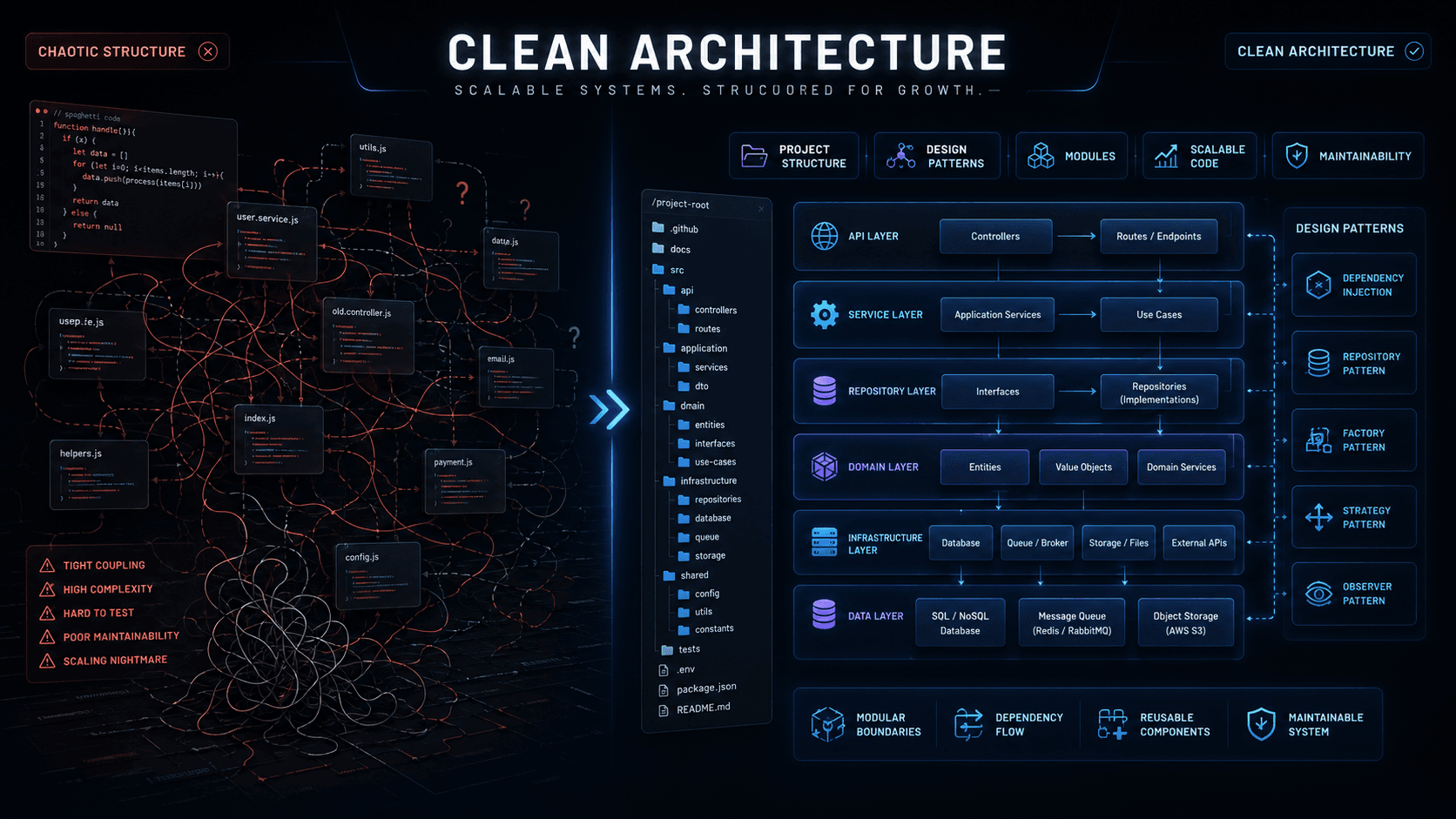
Why Project Structure and Design Patterns Matter in Scalable Software
When people talk about scalable software, they usually think about servers, databases, cloud infrastructure, caching, queues, load balancers, and deployment pipelines.
Those things are important.
But scalability does not start only from infrastructure.
It also starts from the codebase.
A product can have powerful servers and still be difficult to scale if the project structure is messy. A backend can run on cloud infrastructure and still become painful to maintain if business logic is scattered everywhere. A frontend can look beautiful and still become hard to improve if components, state, API calls, and UI logic are not organized properly.
Scalable software is not only about handling more users.
It is also about handling more features, more developers, more business rules, more integrations, more changes, and more responsibility over time.
That is why project structure and design patterns matter.
They help a codebase stay understandable as the product grows.
What Project Structure Really Means
Project structure means how the files, folders, modules, services, components, utilities, and business logic are organized inside the codebase.
It answers questions like:
Where should this feature live? Where should API logic go? Where should validation live? Where should business rules be written? Where should database access be handled? Where should shared utilities be placed? Where should background jobs be defined? Where should configuration live? Where should tests be added?
A good project structure makes these answers obvious.
A poor project structure makes every new feature confusing.
When developers do not know where code belongs, they usually place it wherever it is fastest. That may work for a small project, but over time it creates a messy codebase.
The real cost appears later when the team needs to add features, fix bugs, onboard developers, or refactor modules.
What Design Patterns Really Mean
Design patterns are repeatable solutions to common software design problems.
They are not magic rules.
They are not something to use just to sound advanced.
They are practical ways to organize code so it becomes easier to understand, reuse, test, and extend.
Examples of useful patterns include:
Repository Pattern Service Layer Pattern Factory Pattern Strategy Pattern Adapter Pattern Observer/Event Pattern Dependency Injection Module Pattern Middleware Pattern Command Pattern
Each pattern solves a different type of problem.
For example, the Repository Pattern can separate database access from business logic.
The Strategy Pattern can help switch between different behaviors without writing messy conditional logic.
The Adapter Pattern can help integrate third-party services without spreading provider-specific code across the whole application.
The goal of design patterns is not complexity.
The goal is clarity.
Why Structure Matters More as the Product Grows
In the early days of a project, messy structure may not look like a big problem.
There may be only a few screens, a few APIs, and one or two developers.
But as the product grows, the codebase grows too.
New modules are added.
New business rules are added.
New integrations are added.
New user roles are added.
New edge cases appear.
New developers join the project.
Suddenly, the same codebase that felt simple becomes hard to manage.
This is where poor structure creates real problems:
features take longer to build bugs become harder to trace developers duplicate logic business rules are scattered testing becomes difficult deployment becomes risky refactoring becomes expensive new developers need more onboarding time
Good structure reduces this pain.
It keeps the codebase predictable.
Scalable Software Needs Clear Boundaries
One of the most important goals of project structure is creating boundaries.
A boundary means one part of the system has a clear responsibility.
For example, in a backend system:
Auth module handles authentication. User module handles user profile and account data. Organization module handles tenant or workspace logic. Billing module handles subscriptions and payments. Notification module handles email, SMS, and in-app notifications. Report module handles analytics and exports.
When these boundaries are clear, the product becomes easier to understand.
When boundaries are missing, everything becomes connected to everything.
That is when small changes become risky.
For example, changing user logic may accidentally break billing. Updating notification behavior may affect reporting. Modifying authentication may break admin permissions.
Clear module boundaries protect the system from this kind of hidden coupling.
Poor Structure Creates Technical Debt
Technical debt is not only caused by bad code.
It is also caused by unclear structure.
A project can have working code but still be full of technical debt if:
controllers contain too much business logic database queries are copied everywhere validation is inconsistent API responses are different across modules frontend components are too large state management is scattered services depend on too many unrelated things third-party integration code is mixed with core business logic
At first, this may not feel like a problem.
But later, every change becomes slow.
Developers spend more time understanding old code than writing new code.
The product becomes harder to improve.
That is why structure should be treated as part of product quality.
Good Structure Helps Teams Work Faster
A clean project structure helps teams move faster because developers know where things belong.
For example, if a new developer joins the project, they should be able to understand:
where modules are located where API routes are defined where services are written where database logic lives where shared helpers are stored where errors are handled where configuration is managed where tests should be added
This reduces onboarding time.
It also reduces mistakes.
When the codebase has a predictable structure, developers can focus on solving product problems instead of guessing where to place code.
This becomes very important when a project moves from one developer to a team.
Good Structure Improves Maintainability
Maintainability means how easy it is to change, fix, and improve the software over time.
A maintainable codebase is not necessarily the one with the fewest files.
It is the one where responsibilities are clear.
For example:
Controllers should handle request and response. Services should handle business logic. Repositories should handle database access. DTOs should handle input validation. Guards and middleware should handle access and request-level concerns. Processors should handle background jobs. Adapters should handle external services.
When these responsibilities are separated, the code becomes easier to maintain.
If everything is mixed together, maintainability becomes poor.
A single file may work today, but it becomes a problem when the product grows.
Design Patterns Reduce Repetition
Repetition is one of the biggest signs of poor structure.
For example, if the same database query, validation logic, permission check, or API response format is copied across multiple files, the system becomes harder to maintain.
When one rule changes, developers must update it in many places.
This increases the risk of bugs.
Design patterns help reduce this repetition.
For example:
Repository Pattern centralizes database access. Guard Pattern centralizes permission checks. Adapter Pattern centralizes third-party API logic. Factory Pattern centralizes object creation. Strategy Pattern centralizes behavior switching.
The goal is not to make the code abstract for no reason.
The goal is to avoid duplicated logic that becomes expensive later.
Design Patterns Make Change Easier
Software changes constantly.
Clients request new features.
Users give feedback.
Business rules change.
Third-party APIs update.
New payment providers are added.
New notification channels are needed.
New user roles are introduced.
A good design pattern makes change easier.
For example, imagine a product sends notifications through email only.
Later, the client wants SMS, WhatsApp, Slack, and push notifications.
If email logic is hardcoded everywhere, adding new channels becomes messy.
But if notification sending is structured behind a common interface or strategy, adding new channels becomes easier.
That is the practical value of design patterns.
They prepare the system for controlled change.
Example: Payment Provider Integration
Imagine your product uses one payment provider in the beginning.
The simple approach is to call that provider directly from different services.
This may work at first.
But later, the business wants to add another provider.
Now the codebase has provider-specific logic everywhere.
A better approach is to use an adapter pattern.
For example:
PaymentService -> StripeAdapter -> PayPalAdapter -> LocalBankAdapter
The core business logic talks to PaymentService.
The provider-specific details stay inside adapters.
This makes the system cleaner and easier to extend.
Example: Authentication and Authorization
Authentication and authorization are areas where structure matters a lot.
A weak structure may spread permission checks everywhere:
if user.role === "admin" if user.role === "manager" if user.id === record.ownerId
This becomes hard to manage as roles grow.
A better approach is to centralize access control through guards, policies, decorators, or permission services.
For example:
AuthGuard RoleGuard PermissionGuard PolicyEvaluator OwnershipChecker
This makes authorization more consistent.
It also reduces security mistakes.
In scalable SaaS systems, access control should not be random conditions scattered across the codebase.
It should be part of the architecture.
Example: Backend Module Structure
For a scalable backend, a modular structure is usually better than putting everything in one folder.
A simple structure may look like:
src/ modules/ auth/ users/ organizations/ billing/ notifications/ reports/ integrations/ common/ guards/ decorators/ filters/ interceptors/ dto/ database/ config/ queues/
This structure makes the system easier to understand.
Each module owns its responsibility.
Shared logic stays in common areas.
Infrastructure concerns stay separate from business modules.
This does not mean every project must follow exactly this structure.
The structure should match the framework, product, and team.
But the principle is the same: keep responsibilities clear.
Example: Frontend Project Structure
Frontend structure matters too.
A poor frontend structure often creates large components, duplicated API logic, scattered state, and inconsistent UI behavior.
A cleaner structure may separate:
features/ components/ hooks/ services/ lib/ types/ constants/ store/
For example, in a Next.js application, feature-based structure can help organize business areas like:
auth dashboard projects billing settings reports profile
This makes the frontend easier to scale as pages and components increase.
A scalable frontend is not just about good UI.
It is also about clean component boundaries and predictable data flow.
Structure Helps Testing
Testing becomes easier when the code is structured properly.
If business logic is mixed directly inside controllers or UI components, it becomes hard to test.
But when logic is separated into services, helpers, strategies, or modules, it becomes easier to test each part independently.
For example:
test permission logic without starting the full server test pricing calculation without rendering the UI test payment adapter with mocked provider response test email template generation without sending real email test report generation without calling the controller
Good structure makes testing practical.
Poor structure makes testing painful.
Structure Helps Debugging
When a production issue happens, clean structure makes debugging easier.
For example, if an email is not sending, you know where to check:
email service email queue email processor email provider adapter email logs
If a permission issue happens, you know where to check:
auth guard permission service policy evaluator user role mapping request context
If code is scattered, debugging becomes guesswork.
A structured project reduces the time needed to locate problems.
Structure Helps Scaling the Team
A one-person project can survive messy structure for some time.
A team project cannot.
When multiple developers work on the same codebase, structure becomes even more important.
Without clear structure, developers may:
modify the same files too often duplicate logic create inconsistent APIs break unrelated modules introduce conflicting patterns slow each other down
With clear structure, developers can work on different modules with less conflict.
For example:
one developer works on billing one works on notifications one works on reports one works on auth
Good architecture helps teams work in parallel.
Structure Helps Future Refactoring
No architecture is perfect forever.
As a product grows, some refactoring will always happen.
Good structure makes refactoring safer.
For example, if notification logic is already isolated, it is easier to move it into a queue later.
If payment provider logic is already behind an adapter, it is easier to add another provider.
If database access is separated, it is easier to optimize queries.
If modules have clear boundaries, it is easier to split them later if needed.
Poor structure makes refactoring risky because everything is connected.
Design Patterns Should Not Be Forced
Design patterns are useful, but they should not be forced everywhere.
A common mistake is using too many patterns too early.
This creates unnecessary complexity.
For example, a small MVP does not need every enterprise architecture pattern.
Not every service needs a factory.
Not every feature needs a complex abstraction.
Not every project needs microservices, CQRS, event sourcing, or a heavy domain-driven design structure.
Good engineering is about choosing the right level of structure for the product stage.
The goal is not to impress developers.
The goal is to make the product easier to build and maintain.
Avoid Under-Engineering and Over-Engineering
There are two common mistakes.
The first is under-engineering.
This means building everything quickly with no structure.
It creates technical debt and future rebuild cost.
The second is over-engineering.
This means adding too much architecture before the product needs it.
It slows development and makes simple features harder than necessary.
The best approach is balanced engineering.
For an MVP, use simple but clean structure.
For a scalable product, use modular architecture and useful patterns.
For an enterprise product, add stronger boundaries, policies, observability, auditability, and infrastructure discipline.
The architecture should match the product stage.
My Preferred Approach
For scalable software, I usually prefer a practical structure:
Start with clear modules. Keep business logic out of controllers. Separate database access where needed. Use DTOs or schemas for validation. Keep third-party integrations behind adapters. Centralize authentication and authorization logic. Use queues for slow or retryable background work. Keep shared utilities organized. Use consistent API response and error handling. Add patterns only when they solve a real problem.
This approach keeps the codebase clean without making it unnecessarily complex.
It also helps the product move from MVP to scalable and enterprise versions more smoothly.
How This Helps Clients
Clients may not always care about folders, patterns, or architecture terms.
But they care about outcomes.
Good structure helps clients because:
features can be added faster bugs can be fixed more safely new developers can join more easily the product can grow without full rebuilds integrations can be added with less risk security rules stay consistent maintenance cost becomes lower technical debt stays controlled
So project structure is not only a developer concern.
It is a business concern.
A messy codebase increases long-term cost.
A structured codebase protects the product investment.
Final Thoughts
Scalable software is not only about cloud infrastructure.
It starts inside the codebase.
A clean project structure and the right design patterns help the system stay understandable, maintainable, testable, and extendable as the product grows.
Poor structure may not hurt on day one.
But it becomes expensive when new features, new developers, new integrations, and new business rules are added.
Good structure does not mean over-engineering.
It means making responsibilities clear, reducing duplication, protecting boundaries, and choosing patterns that solve real problems.
The best software systems are not only built to work today.
They are built to change tomorrow.
Frequently asked questions
- Why is project structure important in software development?
- Project structure is important because it keeps the codebase organized as the product grows. It helps developers understand where code belongs, reduces duplication, improves maintainability, and makes future changes easier.
- What are design patterns in software development?
- Design patterns are reusable solutions to common software design problems. They help organize code, separate responsibilities, reduce duplication, and make systems easier to extend and maintain.
- Does every project need design patterns?
- No. Design patterns should be used when they solve a real problem. Small projects need simple structure, while scalable and enterprise systems usually need stronger architectural patterns.
- How does poor project structure create technical debt?
- Poor structure causes duplicated logic, scattered business rules, large files, inconsistent APIs, and tightly coupled modules. Over time, this makes development slower, bug fixing harder, and refactoring more expensive.
- What is the best project structure for scalable software?
- There is no single best structure for every project. A good scalable structure usually has clear modules, separated business logic, organized shared utilities, centralized authentication/authorization, clean API layers, and isolated third-party integrations.