JWT, Sessions, Redis, and Token Versioning in Production SaaS Systems
JWT authentication looks simple in tutorials, but production SaaS systems need more than token generation. This article explains how JWTs, sessions, Redis, refresh tokens, and token versioning work together to support secure, scalable, and revocable authentication.
- #jwt
- #sessions
- #redis
- #token-versioning
- #authentication
- #saas
- #backend-architecture
- #nestjs
- #security
- #refresh-tokens
- #session-management
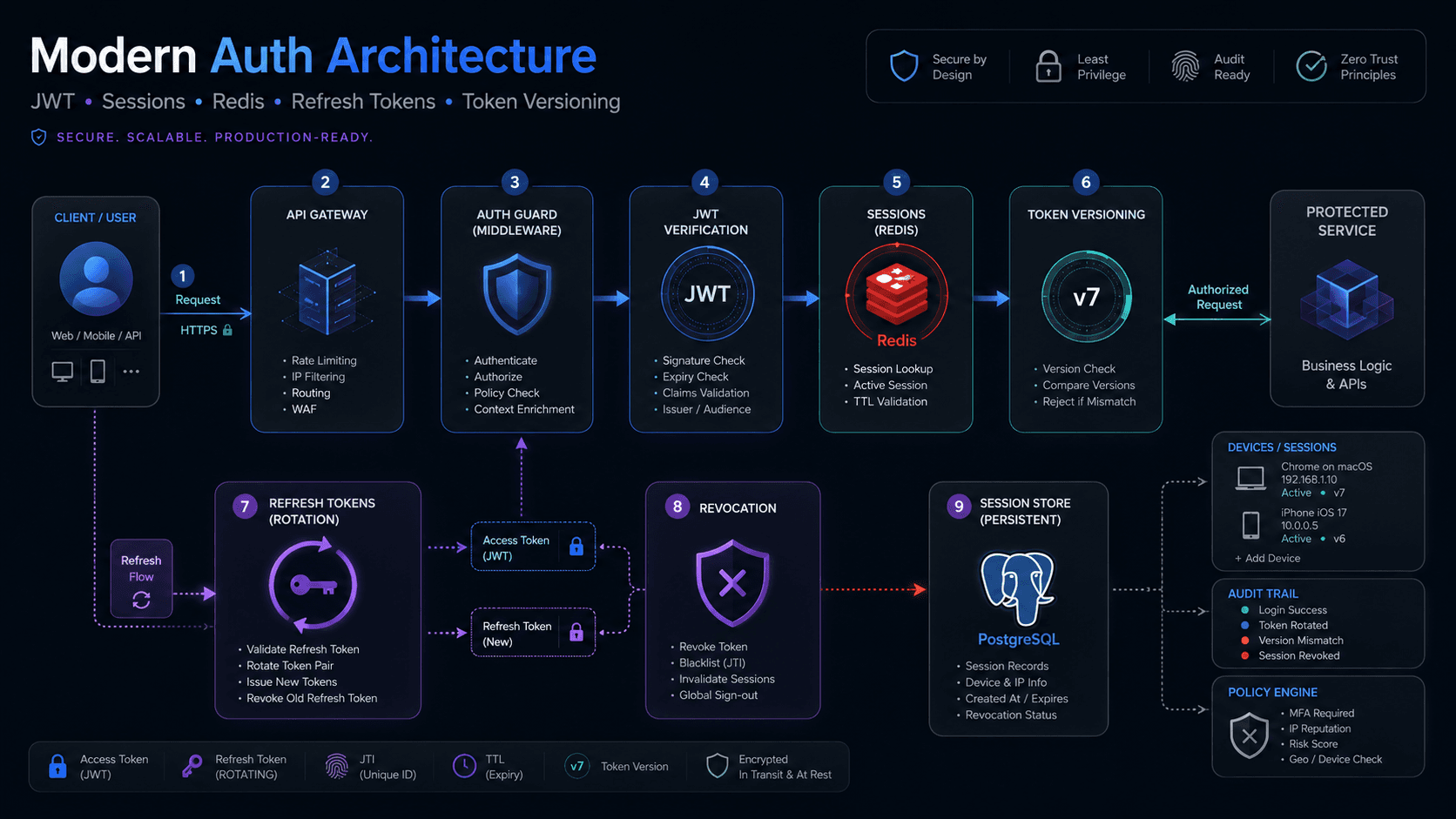
JWT, Sessions, Redis, and Token Versioning in Production SaaS Systems
JWT authentication looks simple when you first learn it.
A user logs in. The backend generates a token. The frontend sends that token with every request. The backend verifies it. If the token is valid, the user gets access.
That flow works well in tutorials.
But production SaaS systems are different.
In real products, users log in from multiple devices. Admins change roles and permissions. Users reset passwords. Teams remove members. Organizations suspend accounts. Security events happen. Tokens can be stolen. Sessions need to be revoked. Access must update quickly when permissions change.
This is where simple JWT authentication becomes incomplete.
A production SaaS system usually needs a mix of:
short-lived JWT access tokens
secure refresh tokens
server-side session records
Redis-backed session and version checks
token versioning
permission versioning
refresh token rotation
logout and logout-all flows
device-level session tracking
The goal is not only to authenticate users.
The goal is to control access safely over time.
JWT Is Useful, But It Is Not the Whole Auth System
JWT stands for JSON Web Token.
In backend systems, JWTs are commonly used as access tokens. They contain signed claims about the user, such as user ID, organization ID, session ID, role, or token version.
The biggest benefit of JWT is that the backend can verify it quickly without reading the database on every request.
That is useful for performance.
But JWTs have one major limitation:
Once a JWT is issued, it remains valid until it expires unless you add a revocation strategy.
This is where many beginner authentication systems fail.
For example, imagine a user logs in and receives a JWT that expires in seven days. After two days, the user changes their password. Should the old token still work?
No.
But if the backend only verifies the JWT signature and expiry, the old token may still be accepted.
That is dangerous.
This is why production systems usually keep JWT access tokens short-lived and combine them with server-side controls.
Access Tokens Should Be Short-Lived
In a production SaaS system, access tokens should usually be short-lived.
The access token is used to call protected APIs. If it is stolen, the attacker can use it until it expires.
A shorter lifetime reduces the damage window.
For example:
Access token lifetime: 5 to 15 minutesRefresh token lifetime: days or weeks, depending on security requirements
This does not mean the user has to log in every 15 minutes.
The frontend can use a refresh token to get a new access token silently.
This gives a good balance:
access tokens remain fast
stolen access tokens expire quickly
users stay logged in
refresh tokens can be controlled more strictly
This is why serious SaaS products should avoid long-lived access JWTs.
Refresh Tokens Handle Long-Lived Login
A refresh token is used to get a new access token when the old one expires.
Unlike access tokens, refresh tokens should be treated as highly sensitive.
In many systems, refresh tokens are:
stored securely
rotated after every use
linked to a session
revocable from the backend
tracked per device
invalidated after password changes
invalidated after suspicious activity
A good refresh flow looks like this:
User logs in.Backend creates a session record.Backend issues a short-lived access token.Backend issues a long-lived refresh token.Access token expires.Frontend calls refresh endpoint.Backend validates refresh token and session.Backend rotates the refresh token.Backend returns a new access token.
This is much safer than issuing one long-lived JWT and trusting it forever.
Sessions Are Still Important
Some developers think JWTs replaced sessions.
That is not fully true.
JWTs are useful for stateless verification, but sessions are still important when the system needs control.
A session record helps answer questions like:
Which device is the user logged in from?
When did this session start?
When was it last used?
Has this session been revoked?
Was this session created after the last password change?
Which refresh token family belongs to this session?
Should this specific device be logged out?
Should all sessions be logged out?
Without session records, logout and revocation become weak.
For example, if a user clicks “logout from all devices,” the backend needs a way to invalidate all active sessions.
If there are no server-side session records, this becomes difficult.
That is why many production systems use a hybrid approach:
JWT for fast API authenticationSession records for control, tracking, and revocationRedis for fast session and version checks
Where Redis Fits In
Redis is useful because it is fast and works well for temporary authentication data.
In production SaaS authentication, Redis can be used for:
session cache
refresh token lookup
token denylist
permission version cache
user status cache
organization status cache
rate limiting
login attempt tracking
password reset token storage
email verification token storage
temporary MFA challenges
The main reason to use Redis is speed.
You do not want every API request to run multiple database queries just to verify the user, session, organization, and permissions.
Redis can store small, frequently accessed auth data with expiration.
For example, after verifying a JWT, the backend may check Redis for:
session:{sessionId}user-token-version:{userId}membership-version:{membershipId}permissions-version:{organizationId}:{userId}
This allows the system to quickly reject tokens that are technically valid but no longer allowed.
Token Versioning Solves Real Revocation Problems
Token versioning is one of the most practical patterns for production authentication.
The idea is simple.
You store a version number on the user, session, membership, or permission record. When issuing a token, you include that version in the JWT claims.
Later, when the token is used, the backend compares the token version with the current version stored in Redis or the database.
If they do not match, the token is rejected.
Example:
JWT contains:
userId: user_123
sessionId: session_456
tokenVersion: 3
permissionsVersion: 8
Current backend state:
user:user_123:tokenVersion = 4
user:user_123:permissionsVersion = 8
The token has tokenVersion = 3, but the current version is 4.
That means the token is old and should be rejected.
This is useful after:
password change
logout from all devices
account compromise
user suspension
session revocation
organization membership removal
role or permission changes
admin security reset
Instead of maintaining a huge denylist of every old JWT, the system can invalidate groups of tokens by increasing a version number.
Permission Versioning Is Important in SaaS
In SaaS systems, authentication is not enough.
A user may be logged in, but their permissions can change.
For example:
an admin removes a user from a team
a manager loses access to reports
a company owner changes a member’s role
a user is suspended from an organization
an enterprise customer updates policies
If the JWT contains permissions directly and the token lives for 15 minutes, the user may keep old permissions until the token expires.
For low-risk apps, that may be acceptable.
For serious SaaS systems, permission changes should apply quickly.
This is where permission versioning helps.
The token can include:
permissionsVersion: 12
The backend checks the current version:
currentPermissionsVersion: 13
If the versions do not match, the backend can reject the token or force the client to refresh.
This helps keep access control closer to real-time without putting too much data inside the JWT.
Avoid Putting Too Much Data Inside JWTs
JWTs should be small.
A common mistake is putting too much information inside them:
full user profile
full role list
all permissions
organization details
settings
subscription data
feature flags
This creates problems.
First, the token becomes large and is sent with every request.
Second, the data becomes stale.
Third, if roles or permissions change, the old token may still contain old access claims.
For production SaaS systems, I usually prefer slim JWTs.
A good JWT may contain:
sub
userId
sessionId
organizationId
membershipId
tokenVersion
permissionsVersion
iat
exp
Then the backend can load or cache additional authorization context when needed.
This gives more control and keeps tokens safer and cleaner.
Redis Should Not Be the Only Source of Truth
Redis is fast, but it should not always be the permanent source of truth.
For authentication systems, the database should usually keep the durable records:
users
sessions
refresh token families
organizations
memberships
roles
permissions
audit logs
Redis can cache the hot data.
If Redis restarts or cache expires, the system should be able to rebuild required state from the database.
This is an important architecture principle.
Use Redis for speed.
Use the database for durability.
Refresh Token Rotation Reduces Risk
Refresh token rotation means every time a refresh token is used, the backend invalidates it and issues a new one.
This protects the system from replay attacks.
For example:
Refresh token A is issued.Client uses token A to get a new access token.Backend invalidates token A.Backend issues refresh token B.If token A is used again, backend detects reuse.
If an old refresh token is reused, it may mean the token was stolen.
At that point, the system can revoke the entire token family or session.
This is stronger than using the same refresh token again and again.
For production SaaS authentication, refresh token rotation is a strong pattern because it gives the backend better control over long-lived login sessions.
Logout Needs Backend Support
Logout is easy in a frontend-only view.
You remove the token from local storage or memory, redirect to login, and call it done.
But that is not enough for production.
If the refresh token still works, the session is not really logged out.
A proper logout should:
revoke the current session
invalidate the refresh token
clear secure cookies if used
optionally denylist the current access token until expiry
update session status in the database
remove or update Redis session cache
For “logout from all devices,” the backend should revoke all sessions or increment the user token version.
This is why sessions and token versioning are important.
Password Change Should Invalidate Old Sessions
When a user changes their password, old sessions should usually be invalidated.
This protects the user in case the old password was compromised.
A common pattern is:
User changes password.Backend updates password hash.Backend increments tokenVersion.Backend revokes existing refresh token families.Backend clears session cache.User logs in again or keeps only the current verified session.
This ensures old tokens cannot continue accessing the account.
Without token versioning or session revocation, password change may not fully protect the user.
Role Changes Should Update Access Quickly
In SaaS systems, role changes are common.
For example:
owner changes member to manager
manager becomes viewer
employee is removed from workspace
admin permissions are reduced
team access changes
If access is only controlled by a long-lived JWT, these changes may not apply immediately.
That creates security and business problems.
A better pattern is to keep permission versioning.
When roles or permissions change:
Update membership/role records.Increment permissionsVersion.Clear related Redis authorization cache.Force old tokens to refresh or reject them.
This makes the system more responsive to access changes.
Multi-Tenant SaaS Needs Stronger Session Context
In multi-tenant SaaS systems, a user may belong to multiple organizations.
For example, one user may be:
owner in one workspace
manager in another workspace
viewer in another organization
This means authentication cannot only answer “who is the user?”
It also needs to answer:
“Which organization is the user currently operating inside?”
A production JWT for multi-tenant SaaS may include:
userIdorganizationIdmembershipIdsessionIdtokenVersionpermissionsVersion
The backend should verify that:
the user exists
the session is active
the organization is active
the membership is active
the permission version is current
the user is allowed to access the requested resource
This is what separates basic login from production SaaS authentication.
Token Storage Matters
Where tokens are stored matters.
A safer browser strategy is:
keep access token in memory
store refresh token in an HttpOnly, Secure, SameSite cookie
avoid localStorage for sensitive tokens
scope refresh cookies to the refresh endpoint where possible
rotate refresh tokens
use CSRF protection where required
Local storage is easy, but it increases risk if the app has an XSS vulnerability.
Cookies also have their own security considerations, especially around CSRF, but HttpOnly cookies protect refresh tokens from JavaScript access.
The right strategy depends on the app, but token storage should be planned, not added randomly.
Common Mistakes I Avoid
Here are mistakes I avoid in production SaaS authentication:
using long-lived access tokens
storing sensitive tokens in localStorage
putting all permissions inside JWTs
skipping refresh token rotation
not tracking sessions
not supporting logout from all devices
not invalidating tokens after password change
not updating access after role changes
using Redis as the only durable store
ignoring multi-device login behavior
not logging security events
treating authentication as a one-time login feature
Authentication is not just a login page.
It is a continuous security layer across the whole product.
My Preferred Production Pattern
For production SaaS systems, I usually prefer this pattern:
Access Token: Short-lived JWT used for API requests.
Refresh Token: Long-lived opaque token, securely stored, rotated on every use.
Session: Server-side record connected to device, refresh token family, user, and organization context.
Redis: Fast cache for session state, token versions, permission versions, rate limits, and temporary auth flows.
Database: Durable source of truth for users, sessions, memberships, roles, permissions, refresh token families, and audit logs.
Token Versioning: Used to invalidate old tokens after security-sensitive changes.
Permission Versioning: Used to quickly apply role and access-control changes.
This gives a good balance between performance and control.
It avoids the weakness of purely stateless JWT authentication while still keeping API verification fast.
Final Thoughts
JWT authentication is not wrong.
The problem is treating JWT as the entire authentication system.
In production SaaS systems, authentication needs to support real business and security situations: logout, password changes, role changes, account suspension, organization access, device sessions, refresh token rotation, and compromised-token response.
That requires more than signing a token.
A strong production authentication system combines JWTs, sessions, Redis, refresh tokens, and token versioning.
JWTs provide speed.
Sessions provide control.
Redis provides fast state checks.
Refresh tokens provide long-lived login.
Token versioning provides revocation.
Together, they create an authentication system that can support real SaaS growth without becoming insecure or impossible to maintain.
Frequently asked questions
- Are JWTs enough for production SaaS authentication?
- JWTs are useful, but they are not enough alone for most production SaaS systems. You usually also need refresh tokens, sessions, Redis-backed state checks, logout support, revocation, and token versioning.
- Why use Redis with JWT authentication?
- Redis helps store and check fast-changing authentication state such as active sessions, token versions, permission versions, denylisted tokens, login attempts, and temporary verification flows without querying the database on every request.
- What is token versioning?
- Token versioning is a pattern where a version number is stored on the user, session, or membership record and included in issued tokens. If the backend version changes, old tokens become invalid.
- Should refresh tokens be rotated?
- Yes, refresh token rotation is recommended for stronger security. Every time a refresh token is used, the backend invalidates it and issues a new one. Reuse of an old refresh token can indicate token theft.
- Where should access and refresh tokens be stored in a web app?
- A safer approach is to keep access tokens in memory and store refresh tokens in HttpOnly, Secure, SameSite cookies. Avoid storing sensitive tokens in localStorage because XSS vulnerabilities can expose them.