Why Cheap Software Development Becomes Expensive Later
Cheap software development looks attractive in the beginning, but it often creates hidden costs through poor architecture, weak planning, technical debt, security gaps, and expensive rebuilds later. This article explains why serious software products need the right foundation from day one.
- #software-development
- #saas
- #project-planning
- #technical-debt
- #scalable-architecture
- #startup-development
- #product-engineering
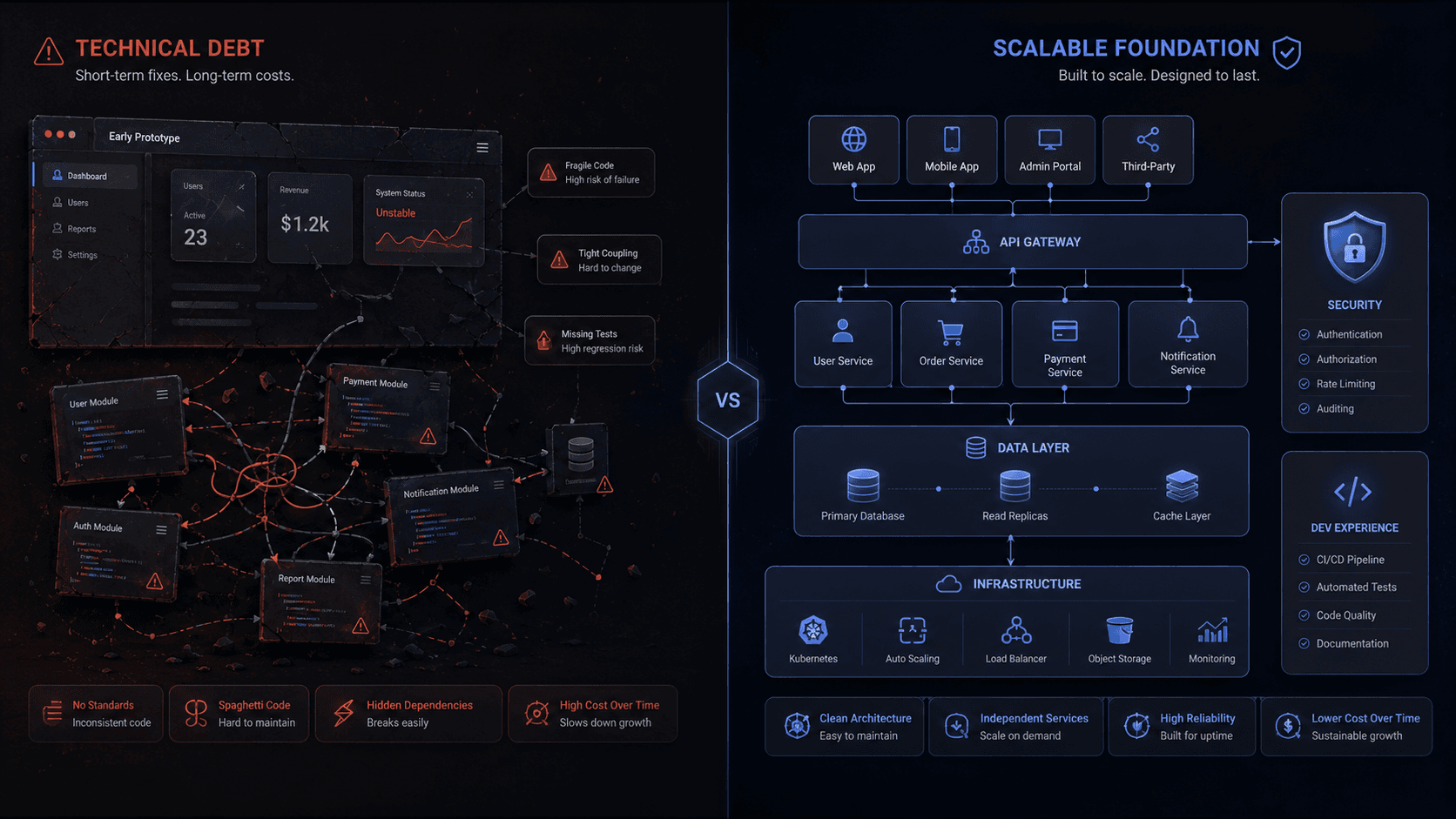
Why Cheap Software Development Becomes Expensive Later
Every business wants to save money when starting a software project. That is normal. Whether it is a SaaS platform, mobile app, admin dashboard, marketplace, CRM, AI product, or internal business system, the first thought is usually:
“Can we build this faster and cheaper?”
The answer is yes, but only to a certain limit.
Cheap development becomes dangerous when the goal is only to reduce the initial cost without thinking about the product’s future. A low-cost build may look fine in the first demo, but the real problems usually appear later when users start using the system, new features are requested, integrations are added, or the business starts growing.
That is when cheap development becomes expensive.
The problem is not always the price itself. The real problem is what gets skipped to make the price low: planning, architecture, clean code, security, scalability, testing, documentation, and long-term maintainability.
Cheap Development Usually Focuses Only on Screens
Many low-cost software projects start with one goal: make the UI look complete as fast as possible.
The screens may look good. The buttons may work. The client may see a quick demo and feel that the project is almost done.
But behind the UI, the system may be weak.
There may be no proper backend structure. APIs may be written without validation. Database tables may not be planned correctly. Authentication may be basic. Roles and permissions may be hardcoded. Error handling may be missing. Logs may not exist. The code may work for one user but fail when multiple users start using the product.
This is a common reason why cheap software looks complete but fails in real usage.
A serious product is not only screens. It is a full system.
It needs:
clean frontend structure
reliable backend APIs
secure authentication
proper database design
scalable business logic
role-based access
error handling
logging
deployment planning
future feature flexibility
When these things are skipped, the product becomes difficult to improve later.
MVP Does Not Mean Poor Quality
One of the biggest misunderstandings in software development is the meaning of MVP.
Many people think MVP means:
“Build it as cheaply as possible.”
That is not correct.
MVP means:
“Build the smallest useful version of the product that can validate the business idea.”
Small does not mean messy. Simple does not mean unplanned. Fast does not mean careless.
A good MVP should be simple, but it should still have a clean foundation. It should allow the business to test the idea without creating a future technical trap.
For example, if you are building a SaaS MVP, you may not need advanced analytics, automation, billing tiers, audit logs, and enterprise features on day one. But you still need a good structure for users, organizations, roles, permissions, data ownership, and secure access.
If the MVP is built with no structure, then every future feature becomes harder.
That is when the business starts hearing:
“This will take more time than expected.”
“We need to rewrite this module.”
“This feature is not possible with the current structure.”
“The database needs to be changed.”
“The previous developer did not plan this properly.”
At that stage, the MVP is no longer saving money. It is creating cost.
The Hidden Cost Is Technical Debt
Technical debt is the cost of shortcuts.
Sometimes shortcuts are acceptable. In early-stage products, not everything needs to be perfect. But shortcuts become dangerous when they are taken without understanding the future impact.
Technical debt can appear in many ways:
duplicated code
hardcoded business rules
poor database relationships
missing validation
no error handling
weak authentication
no role-based access control
unorganized folder structure
tightly coupled modules
no documentation
no testing strategy
no logging or monitoring
poor deployment setup
At first, technical debt is invisible to the business. The app may still run. The UI may still look fine.
But later, technical debt slows everything down.
A feature that should take two days starts taking two weeks. A small change breaks another module. A new developer cannot understand the code. Bugs keep coming back. Performance becomes poor. The business loses confidence in the product.
This is why cheap development becomes expensive: the cost does not disappear. It moves into the future.
Poor Architecture Makes Every Future Feature Harder
Architecture is not only for big enterprise systems. Even small products need the right level of architecture.
Good architecture answers important questions:
Where should business logic live?
How should modules communicate?
How should data be stored?
How should users and roles be managed?
How will the system scale when traffic increases?
How will new features be added?
How will integrations be handled?
How will errors be tracked?
How will security be maintained?
Cheap development often ignores these questions.
The result is a system where everything is connected to everything. One module depends on another module in the wrong way. API responses are inconsistent. Database changes become risky. New features require rewriting old code.
This is especially dangerous for SaaS products.
A SaaS product usually grows over time. It may start with one type of user, then add teams, organizations, subscriptions, permissions, reports, integrations, notifications, analytics, and automation.
If the foundation is weak, growth becomes painful.
Security Problems Are Expensive to Fix Later
Security is one area where cheap development can become very risky.
In many low-cost projects, security is treated as a small task:
add login
store password
generate token
protect routes
But production security is more than that.
A reliable system needs secure password hashing, token expiration, refresh token handling, role-based access, protected APIs, input validation, rate limiting, secure cookies where needed, environment variable protection, and safe deployment practices.
For SaaS and business applications, security becomes even more important because the system may store customer data, financial records, documents, messages, or business operations.
If security is not planned from the beginning, fixing it later can be expensive because authentication and authorization usually touch the entire system.
You may need to update:
database schema
user sessions
API guards
frontend route protection
admin permissions
organization-level access
audit logs
deployment configuration
That is why security should not be treated as an optional feature. It is part of the product foundation.
Bad Database Design Can Force a Rebuild
The database is one of the most important parts of any software product.
A poor UI can be redesigned. A weak page can be improved. But a badly designed database can affect the entire system.
Cheap development often starts database design quickly without thinking deeply about relationships, future features, reporting needs, permissions, and data ownership.
For example, in a SaaS product, if users are not properly connected to organizations or tenants, adding multi-tenant features later becomes difficult. If orders, invoices, payments, or activity logs are not structured correctly, reporting becomes painful. If roles and permissions are hardcoded instead of modeled properly, access control becomes messy.
Bad database design creates long-term problems:
data duplication
inconsistent records
slow queries
difficult reporting
broken relationships
risky migrations
limited scalability
expensive refactoring
Many software rebuilds happen not because the UI was bad, but because the data model was not planned correctly.
Cheap Code Usually Becomes Expensive for New Developers
A project is not finished when the first developer completes it. Most real products continue for months or years.
New developers may need to add features, fix bugs, improve performance, or integrate third-party services.
If the codebase is clean, structured, and documented, new developers can understand it quickly.
If the codebase is messy, every new developer needs extra time just to understand what is happening.
This creates hidden cost.
The business pays for:
onboarding time
debugging time
reverse engineering
refactoring
rewriting
fixing old mistakes
delays in delivery
Sometimes a new developer may even say:
“It is better to rebuild this from scratch.”
That is usually the most expensive moment in a software project.
Integrations Become Difficult Without Planning
Modern software products rarely work alone.
They often need integrations with:
payment gateways
CRM systems
email services
SMS providers
AI models
analytics tools
accounting systems
calendars
maps
file storage
third-party APIs
Cheap development usually handles integrations in a quick way. The goal is only to make the integration work once.
But production integrations need proper planning.
You need to think about:
API failures
retries
webhooks
background jobs
queues
logging
rate limits
duplicate events
security keys
data synchronization
error recovery
Without this planning, integrations become unstable.
A payment may succeed but not update in the database. A webhook may fail silently. An email may not send. An AI request may timeout. A third-party API limit may break the user flow.
These problems damage user trust and increase support cost.
Performance Problems Usually Appear After Launch
A cheap system may work fine during development because only a few people are testing it.
But after launch, real users behave differently. They upload files, search data, refresh pages, submit forms, use mobile networks, trigger background tasks, and create unexpected load.
Performance issues appear when the system was not planned for real usage.
Common problems include:
slow database queries
no caching
large API responses
unoptimized images
heavy frontend bundles
no pagination
no background processing
blocking operations
weak server configuration
no monitoring
Performance is not only a technical issue. It directly affects business.
If the app is slow, users leave. If the dashboard takes too long to load, teams stop using it. If reports fail, management loses trust. If the checkout is slow, revenue is affected.
Fixing performance later is harder than planning basic performance from the beginning.
Cheap Development Can Damage Business Reputation
When software fails, users do not blame the code. They blame the business.
Users do not care that the project was built cheaply. They only see bugs, slow screens, failed payments, missing data, broken login, or poor experience.
This can damage:
customer trust
brand image
investor confidence
team productivity
sales demos
client relationships
For startups, this is especially dangerous. A bad first version can make users lose confidence before the product gets a real chance.
A stable product does not need to be perfect, but it should feel reliable.
Reliability comes from good planning and responsible engineering.
The Real Goal Is Not Expensive Development
This does not mean every project needs a huge budget or enterprise-level architecture from day one.
That is also a mistake.
The goal is not to make development expensive.
The goal is to make development responsible.
A smart software plan balances cost, speed, and quality.
For an MVP, you can keep features limited. You can avoid unnecessary complexity. You can delay advanced modules. You can use existing tools where possible. You can build only what is needed for validation.
But you should not compromise the foundation.
A good developer or software team should help you decide:
what to build now
what to delay
what should be scalable from day one
what can be simple for now
what shortcuts are safe
what shortcuts will become expensive later
This is where experience matters.
What Good Development Looks Like
Good development is not only about writing code.
It includes:
understanding the business goal
planning the product flow
choosing the right architecture
designing the database properly
creating clean APIs
securing authentication and authorization
writing maintainable frontend and backend code
planning deployment
preparing for future features
keeping the system understandable for other developers
Good development gives the business a product that can grow.
It does not mean the first version will have every feature. It means the first version will not block the second version.
That is the difference between cheap software and smart software.
A Practical Example
Imagine two businesses building the same SaaS product.
The first business chooses the cheapest option. The team builds screens quickly, creates basic APIs, stores data without a strong model, adds simple login, and launches fast.
The demo looks good.
But after launch, the business needs subscriptions, team accounts, permissions, reports, notifications, and integrations. Suddenly, every feature becomes difficult. The developers need to change the database, rewrite APIs, fix authentication, and clean old code. The business loses months.
The second business builds a focused MVP but with a better foundation. It does not build every advanced feature, but it plans users, organizations, roles, database relationships, API structure, and deployment properly.
The first version may take slightly more effort, but the second and third versions move faster.
That is the value of good engineering.
How to Avoid Expensive Rebuilds
Before starting a software project, businesses should ask the right questions:
What problem are we solving?
Who are the users?
What features are required for MVP?
What features may come later?
Will this product need roles and permissions?
Will this product support multiple organizations or teams?
Will it need payments or subscriptions?
Will it integrate with third-party services?
What data will be stored?
What reports will be needed?
What security level is required?
How will the system be deployed?
Who will maintain the product later?
These questions help reduce future cost.
The goal is not to plan everything perfectly. The goal is to avoid building blindly.
Final Thoughts
Cheap software development becomes expensive when it ignores the future.
A low initial price may feel safe, but if the product is built without proper planning, structure, security, and scalability, the business eventually pays more through bugs, delays, failed features, poor performance, and rebuilds.
The best approach is not always the most expensive one.
The best approach is the one that matches the product stage while protecting the future.
For an MVP, build small — but build clean.
For a growing product, invest in scalability.
For an enterprise product, plan security, reliability, and maintainability from the beginning.
Good software development is not just about delivering features. It is about building a product that can survive real users, real business needs, and future growth.
Frequently asked questions
- Why does cheap software development become expensive later?
- Cheap development often skips planning, architecture, security, testing, and maintainability. These shortcuts create technical debt, bugs, scalability issues, and future rebuild costs.
- Is MVP development supposed to be cheap?
- MVP development should be focused, not careless. A good MVP includes only the most important features, but it still needs clean architecture, secure authentication, and a maintainable foundation.
- What is the biggest hidden cost in software development?
- The biggest hidden cost is usually technical debt. It slows down future development, makes bugs harder to fix, increases onboarding time for new developers, and can eventually force a full rebuild.
- How can businesses reduce software development cost without hurting quality?
- Businesses can reduce cost by limiting the first version’s scope, prioritizing core features, avoiding unnecessary complexity, and still investing in proper architecture, database design, and security.